Affidavit for Name Change
Everything downstream copies from this one document. Your newspaper notice copies it, the gazette proforma copies it, and every office you visit afterwards reads it. Twenty minutes spent checking every field against your Aadhaar before you swear is worth more than anything you can do afterwards, because a notarised affidavit cannot be corrected with a pen. This page covers who can actually attest it, where the two gazetted officers requirement genuinely comes from, why there is no fixed stamp paper value, and where witnesses really belong.
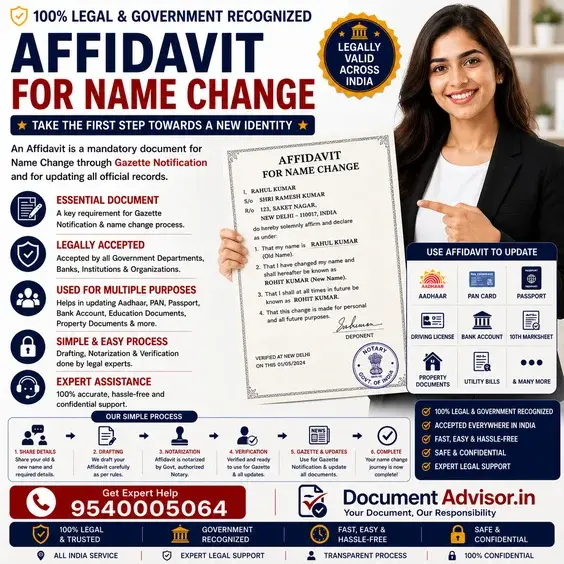
An affidavit for name change is a sworn declaration that the person known by one name is the same individual referred to by a different name. It must be attested by a Judicial or Executive Magistrate, a Notary Public appointed under the Notaries Act, 1952, or a Consular Officer at an Indian Mission abroad; a stamp paper vendor's endorsement is not attestation, and neither is a witness's signature. There is no single stamp paper value that applies across India, since it is a state subject and varies by state and purpose, so ask the notary rather than trust a fixed figure. And the two gazetted officers requirement you may have read about is real, but it belongs to one specific instrument: a Central Government employee's name-change deed under a 1987 Home Ministry Office Memorandum, not an ordinary citizen's affidavit. Once notarised, the affidavit cannot be quietly edited; a mistake means re-executing the whole document.
Why this one document matters so much
Because everything else in a name change copies from it, and it cannot be fixed with a pen once it is sworn.
At a glance
- Once notarised, it cannot be quietly edited. A mistake means new stamp paper, new attestation, and re-running any newspaper advertisement already published on its strength.
- Only three kinds of officer can attest it: a Judicial or Executive Magistrate, a Notary Public, or a Consular Officer at an Indian Mission abroad.
- A stamp vendor's endorsement is not attestation. Neither is a witness's signature. Both are common, genuine mistakes.
- There is no single stamp paper value for India. It differs by state, local practice and purpose; ask the notary rather than a template.
- You do not need two gazetted officers unless you are a Central Government employee executing a name-change deed under a specific 1987 Office Memorandum.
- Witnesses usually belong on the gazette proforma, not the affidavit itself, though practice varies by state, so check before you swear.
- The affidavit must address the exact variation, not a general statement, and a clerical error should be explained as an error, not drafted as a voluntary change.
- Often, an affidavit alone is enough, with no gazette required, for a spelling correction, a marriage surname change, or a mismatched parent's name.
Key takeaways
- Read every field against your Aadhaar and passport before you swear. This single check prevents almost every problem this page describes.
- Attestation is not the same as a stamp. Only a notary, magistrate or empowered consular officer can attest; a vendor cannot.
- The two gazetted officers rule has a narrow home. It belongs to a Central Government employee's deed, not to your affidavit.
- Stamp paper value is a question for your notary, not a number any page, including this one, should hand you as universal.
- One well-drafted affidavit can support several corrections at once, across Aadhaar, PAN, bank and other records.
Step by step: getting the affidavit right
A short document, but the sequence matters, because the last step, attestation, is the one you cannot undo.
- Decide which of the three affidavits you actually need: a correction affidavit for a clerical error, a marriage or divorce linkage affidavit, or a voluntary change affidavit. The wording is different for each, and using the wrong one creates a record that says something you did not mean.
- Write down exactly what each document shows, name by name and document by document, and why the variation exists, whether marriage, a spelling error, an initial rearranged, or transliteration.
- Draft the affidavit to address that exact variation, not a general statement, stating that both names refer to one and the same person.
- Ask your notary what stamp paper value applies in your state, or confirm with the Collector of Stamps for a high-value purpose such as property; consider e-stamp paper where it is available.
- Read every field against your Aadhaar and passport before you swear anything, covered in detail in the next section, since this is where most delays actually happen.
- Get it attested by a Judicial or Executive Magistrate, a Notary Public, or, if you are abroad, a Consular Officer at an Indian Mission, and confirm beforehand whether your state's practice wants witnesses on the affidavit itself.
- If the affidavit supports a gazette application, check the proforma's own witness requirement separately, since it is commonly a different requirement from the affidavit.
- Keep several attested originals. Every institution that updates your name, from your bank to your passport office, keeps its own copy.
Read every field against your Aadhaar first
The single error that wastes the most time is a mismatch between the affidavit and your identity proof. People type a casual spelling, an abbreviated father's name, or an address they left three years ago, and the gazette office returns the file. Weeks gone, and the fee is not refundable.
Before you swear anything, put the draft beside your Aadhaar and passport and check, field by field:
- Your existing name, letter for letter, including spacing and any initial.
- Your new name, the same way, with the given name and surname split decided if a passport is in view.
- Your father's or husband's name, spelled as his own documents spell it, not as your family says it.
- Your address, matching the address proof you will submit.
- Your age or date of birth.
- The place and date of execution.
Who can actually attest it
This catches people out, and it is worth being precise about, because an unattested affidavit is just a piece of paper.
The standard specimen puts it plainly: the affidavit may be signed and attested in the presence of a Judicial Magistrate or an Executive Magistrate, a Notary Public appointed under the Notaries Act, 1952, or a Consular Officer at an Indian Mission abroad.
| Who | Can they attest? |
|---|---|
| Notary Public, appointed under the Notaries Act, 1952 | Yes, and this is what most people use |
| Judicial Magistrate or Executive Magistrate | Yes, and some authorities specifically prefer this level |
| Consular Officer at an Indian Mission abroad | Yes, empowered under the Diplomatic and Consular Officers (Oaths and Fees) Act, 1948; this is the route for Indians overseas |
| A stamp paper vendor | No. A vendor's endorsement is not attestation |
| Your witnesses | No. A witness's signature is not attestation either |
| A gazetted officer, generally | No, except in the one specific case in the next section |
If you are abroad, use the consular route rather than trying to arrange something in India by proxy. An Indian Mission can attest, and for a Central Government employee's deed executed overseas, Embassy or High Commission attestation is what is expected.
The two gazetted officers myth
Several websites state that a name change affidavit must be signed by two gazetted officers. Readers then spend days trying to find two obliging officials for a document that does not require them.
The requirement is real, but it belongs to one specific instrument, not to an ordinary affidavit. A Central Government employee changing their name follows the Ministry of Home Affairs Office Memorandum No. 19016/1/87-Estt(A), dated 12 March 1987. Under that route, the deed is typed on paper rather than stamp paper, and it is signed by two witnesses of the rank of Gazetted Officer of the same Department, with their rubber stamps.
Where witnesses actually go
The answer is clean, though practice varies enough that it is worth checking before you swear.
The affidavit's core requirement is your signature as deponent and the notary's attestation, and in many states that is sufficient for the affidavit itself. The gazette application is where witnesses appear. The prescribed proforma commonly asks for the signatures of two witnesses alongside yours, with their details. That is a different document from the affidavit, submitted at a different stage.
Stamp paper: there is no single answer
Be wary of any page, including a template, that gives you one number for the whole country.
Stamp duty on documents like affidavits is a state subject, collected and set by each state government under its own schedule, so there is no single stamp paper value applicable to every affidavit throughout India. It differs by state, by local execution practice, and by the purpose the affidavit is being prepared for. A fixed amount such as Rs 10, Rs 20 or Rs 100 should not be treated as universally applicable.
Ask the notary
They deal with this daily in your state and will tell you the correct denomination.
Confirm for high-value purposes
The Collector of Stamps, or a local advocate, particularly where the affidavit supports a property matter.
Consider e-stamp paper
Legally valid and increasingly preferred; it removes the risk of a vendor selling the wrong denomination.
E-stamping through the Stock Holding Corporation of India (SHCIL) is widely accepted, including in Delhi, Gujarat and Tamil Nadu among other states. It is not, however, the only e-stamping channel; several states run their own portals instead, such as Maharashtra's own registration department, Karnataka's Kaveri Online, and Telangana's IGRS, so confirm which system your state actually uses before assuming SHCIL applies.
Say what actually happened
This follows straight from our guidance on spelling corrections, and it is where a casually drafted affidavit goes wrong.
The affidavit must address the exact variation, not make a general statement. It should say what the difference is, why it exists, and that both names refer to one and the same person. And it should not describe an error as a voluntary change. If a clerk wrote a name incorrectly and you never used that incorrect version intentionally, it is wrong to draft the affidavit as though you voluntarily changed your name from one to the other. The affidavit should explain the error instead.
| Why the names differ | The affidavit is |
|---|---|
| A clerical or spelling error, never used intentionally | A correction affidavit, explaining the error |
| Marriage, taking a spouse's surname | A marriage linkage affidavit, supporting the marriage certificate |
| Divorce, reverting to a former name | A linkage affidavit, supporting the divorce decree |
| A genuine, deliberate change to a new name | A voluntary change affidavit |
Before drafting, write down exactly what each document shows, name by name and document by document, which version you want to stand going forward, and why the variation exists. That reason determines the wording. A marriage affidavit, a correction affidavit and a voluntary change affidavit are three different documents, and using the wrong one produces a record that says something you did not mean.
When an affidavit alone is enough
A great deal of what is sold in this field assumes a gazette is always needed. It usually is not.
- A single letter or a clear typographical error: an affidavit and correction applications are usually enough, with no gazette.
- A surname change after marriage: the marriage certificate does most of the work, with an affidavit supporting it.
- Reverting after divorce: the decree, where it records the name you are reverting to.
- A mother's name differing between records: a same person affidavit, which is what an authority asking for a "one and same person" certificate actually means; that certificate does not exist as a separate document.
- A property record mismatch: an affidavit bridging the two names, rather than a rectification deed. See our property documents guide for the fuller position.
Sample affidavit formats, by situation
The core declaration is the same everywhere: one and the same person, under two different names. What changes is who the deponent is, and one or two averments specific to the situation. These are structural skeletons to draft from, not ready-to-file documents; have the final wording checked against your own documents before you swear it.
Affidavit for name change of a man
Affidavit for name change of a woman
The same format applies for a woman changing her name for reasons unrelated to marriage. Where the change follows marriage, the specimen commonly adds a marriage-specific averment:
Affidavit for name change of a minor
Sworn by the parent or natural guardian on the minor's behalf, not by the minor.
Affidavit for name change with a gender change
The core declaration is the same as above, but it generally supports, rather than replaces, the Certificate of Identity issued by the District Magistrate under the Transgender Persons (Protection of Rights) Act, 2019, applied for through the National Portal for Transgender Persons, on the basis of self-perceived gender identity, with no proof of surgery required. Aadhaar commonly accepts that certificate directly for a name update; other institutions, including PAN and bank KYC, may still separately ask for a standard affidavit, so it is worth having both ready. Where gender-affirming surgery has been undergone, a revised certificate showing the updated gender marker can be obtained with a certificate from the treating hospital's Medical Superintendent or Chief Medical Officer.
Affidavit for name change of a Government employee
Strictly, this is a deed, not a stamp-paper affidavit, executed under Ministry of Home Affairs Office Memorandum No. 19016/1/87-Estt(A), dated 12 March 1987, covered in full in the two gazetted officers section above. It is typed on plain paper, not stamp paper:
Affidavit for name change in school, and on education documents generally
The standard format applies, with one averment identifying the exact document. For a school, this is most often needed to correct the Transfer Certificate (TC), admission register or leaving certificate before the corrected name can carry forward to the next school, board exam registration, or college admission:
Most schools, Boards and Universities ask for this affidavit alongside the original document and a written request to the Principal or Registrar. Where the child is a minor, the affidavit is sworn by the parent or guardian, in the format covered above. A gazette notification is typically needed only where the difference amounts to a full legal name change rather than a spelling correction; a clerical mismatch on a TC is usually resolved with the affidavit and a request letter alone.
And for a share certificate
A share certificate name change, physical or demat, does not need a different affidavit format either; it uses the same core declaration. What differs is the recipient, and whether one is required at all: SEBI's own standard now accepts self-attested documents for an ordinary physical share name change, without a notarised affidavit, except for transmission of shares on death or a request for duplicate certificates. See our share certificate name change guide for the full physical and demat process.
Practical points
- Keep several attested originals. Every institution that updates your name keeps its own copy, and there will be a lot of them.
- It does not expire. A notarised name change affidavit remains valid; there is no need to re-swear it because it is a few years old.
- You cannot do it entirely online. Physical presence before the notary is required. You can draft it online, buy e-stamp paper online where available, and submit downstream updates online afterwards.
- Original ink signatures. Digital or scanned signatures are not accepted on the declaration and cover letter for a gazette application.
- Keep an editable copy of the text, not just a printout, since several states require the gazette proforma computer-typed, and the application will ask for a soft copy that matches the hard copy exactly.
Common mistakes
- Swearing before a stamp vendor, or treating a vendor's endorsement as attestation.
- Not reading every field against Aadhaar before swearing, when the document cannot be edited afterwards.
- Spelling a father's name as the family says it rather than as his own documents do.
- Using an address you have moved from, so it does not match your address proof.
- Chasing two gazetted officers for an ordinary affidavit, when that requirement belongs to a Central Government employee's deed.
- Putting witnesses on the affidavit when they belong on the gazette proforma, or omitting them where the state does want them.
- Trusting a template's stamp paper value instead of asking the notary.
- Drafting a clerical error as a voluntary change of name, and creating a record of something that never happened.
Cost and timeline
| Item | Typical position |
|---|---|
| Stamp paper | No single value applies across India; confirm the denomination with your notary or the Collector of Stamps |
| Notary attestation | Commonly Rs 100 to Rs 200 together with the stamp paper, varying by state and notary |
| Consular attestation, if abroad | Set by the Indian Mission's own consular fee schedule |
| Gazette notification, only where the underlying name change needs one | Commonly Rs 1,100 for an adult, revised each financial year by the Department of Publication |
| Newspaper advertisements, where a gazette route requires them | Commonly Rs 800 to Rs 4,000 for two papers, varying by publication |
Where can we help with a name change affidavit?
Across India, since the attestation authorities and the general format are consistent even though stamp duty and gazette proforma requirements vary by state.
Deciding which affidavit you need
Correction, marriage or divorce linkage, or a voluntary change, the free question that decides the wording.
Drafting it to address the exact variation
Rather than a general statement that raises more questions than it answers.
Checking every field against your identity documents
Before it is sworn, since that is the one review that cannot happen afterwards.
Confirming your state's witness and stamp paper practice
So you are not caught out at the notary's desk.
What do the terms on this page mean?
Twelve definitions, each written to stand on its own.
- Affidavit
- A sworn written declaration of fact, made voluntarily, and attested by an officer legally empowered to administer oaths.
- Deponent
- The person making and swearing the affidavit; in a name change affidavit, usually the person whose name is changing.
- Attestation
- Formal confirmation by an authorised officer, such as a notary or magistrate, that the deponent appeared and swore the affidavit before them.
- Notary Public
- An officer appointed under the Notaries Act, 1952, empowered to attest affidavits and other documents.
- Executive Magistrate
- A magistrate exercising executive, as opposed to judicial, functions, including administering oaths on affidavits in many states.
- Non-judicial stamp paper
- Stamped paper used for affidavits and similar documents, as distinct from judicial stamp paper used for court fees; its value is set by each state.
- E-stamp
- An electronically generated stamp certificate, a valid substitute for physical stamp paper, issued through authorised state systems including SHCIL in several states.
- Verification clause
- The closing part of an affidavit where the deponent confirms the contents are true, made at a stated place and date.
- Gazette proforma
- The prescribed application form for a Central or State Gazette name change notification, distinct from the affidavit that supports it.
- Same person affidavit
- An affidavit declaring that two different names, appearing on different records, refer to one and the same individual.
- Office Memorandum (OM)
- An administrative circular issued by a Government department; the 1987 OM referenced on this page governs Central Government employees' name-change deeds specifically.
- Certificate of Identity
- The document issued by a District Magistrate under the Transgender Persons (Protection of Rights) Act, 2019, recognising a person's self-perceived gender identity.
Do you need help with a name change affidavit?
An affidavit is a short document and a notary is inexpensive. The value in getting help is the drafting judgement and the field-by-field check, not the paperwork itself.
| Your situation | Do it yourself? | Why |
|---|---|---|
| A clear spelling correction, one document affected | Often yes, using a standard specimen | The wording is simple and well established |
| Unsure which of the three affidavit types applies | Worth a quick check first | The wrong wording creates a record that says something you did not mean |
| Notary asking for a fixed stamp paper value you have not confirmed | Yes, ask them to confirm it directly | There is no universal figure to fall back on |
| Affidavit needs to support several institutions at once | Get advice | One affidavit drafted properly can save four drafted casually |
| A Government employee's deed under the 1987 OM | Get advice | The plain-paper, departmental-witness format is easy to get wrong |
Your Trust and Security First
Your documents stay private
Handled by our own desk in Burari, Delhi, used for your file and nothing else.
We tell you which of the three affidavits you need
Correction, marriage or divorce linkage, or a voluntary change, free to hear.
We check every field before it is sworn
The one review that cannot happen once the affidavit is notarised.
We know where witnesses actually belong
On the gazette proforma in most states, not the affidavit itself.
We draft the exact variation, not a general statement
So the record says precisely what happened and why.
We do not quote you a fixed stamp paper value
Because there is not one; we confirm it with the notary for your state.
Everything You Need, In One Place
Deciding which affidavit you actually need
Free, and it decides the wording that follows.
Drafting to address the exact variation
Man, woman, minor, gender change, Government employee or a specific document, matched to the right format.
Field-by-field checking against your identity documents
Before you swear, since that check cannot happen afterwards.
Confirming your state's stamp paper and witness practice
So you are not caught out at the notary's desk.
Gazette notification filing, where genuinely needed
For a legal change by choice, filed correctly the first time.
Full record sequencing
Aadhaar, PAN, bank, passport and more, done together from one affidavit where possible.
How It Works
Send us the documents showing both versions of the name
We tell you which of the three affidavits applies, and the exact wording it should carry.
We draft it and check every field
Against your Aadhaar and passport, before anything is sworn.
We confirm attestation and stamp paper for your state
So the document is accepted the first time.
The questions people search about a name change affidavit
Is an affidavit the same as a gazette notification?
No. An affidavit is a sworn declaration; a gazette notification is a Government publication of the change. Often only the affidavit is needed. See our main name change and gazette guide for when a gazette is actually required.
I only need to fix a spelling mistake, not a full legal name change. Is the affidavit different?
Yes, the wording differs. See our name spelling correction guide, since a clerical error should be explained as an error, not drafted as a voluntary change.
The mismatch is in my father's or mother's name, not my own. What then?
That is a different correction with its own affidavit wording. See our father's name correction guide or mother's name correction guide, depending on which record is involved.
Does the affidavit correct my birth certificate?
No. A birth certificate error is a Registrar correction under Section 15 of the RBD Act, 1969, handled by the issuing municipal body, not by an affidavit alone.
What should I ask a service before paying for an affidavit?
Whether they are drafting for the exact reason the names differ, or reusing a generic template that may carry the wrong stamp paper value or an unnecessary witness requirement.
Send us the documents before you draft anything yourself
Talk to the desk
Phone: 9540005002
WhatsApp: 9540005064
Email: support@documentadvisor.in
Hours: Monday to Saturday, 9 AM to 6 PM
Office: Near Hanuman Mandir, Metro Pillar No. 376, Near Burari Metro Station, Shop No. 2nd Ground Floor, Gali No. 1, Plot No. 31/12, Hardev Nagar, Jharoda Majra, Burari, Delhi 110084
Frequently asked questions
Can I correct a mistake on the affidavit after it is notarised?
No. Once notarised it cannot be quietly edited. It has to be re-executed on fresh stamp paper with fresh attestation, and if a newspaper advertisement has already run on it, that goes again too.
Who can attest the affidavit?
A Judicial Magistrate or Executive Magistrate, a Notary Public appointed under the Notaries Act, 1952, or a Consular Officer at an Indian Mission abroad. Most people use a notary.
Can a stamp paper vendor attest it?
No. A vendor's endorsement is not attestation, and neither is a witness's signature. Only a notary, magistrate or empowered consular officer can attest.
What stamp paper value do I need?
There is no single value that applies throughout India. It differs by state, local practice and purpose, so ask the notary or confirm with the Collector of Stamps. Be wary of any template that states a fixed figure.
Can I use e-stamp paper?
Yes. E-stamp is legally valid and increasingly preferred. SHCIL issues it in several states, including Delhi, Gujarat and Tamil Nadu, while some states such as Maharashtra and Karnataka run their own separate e-stamping portals.
Do I need two gazetted officers to sign?
Not for an ordinary affidavit. That requirement belongs to a Central Government employee's deed under Ministry of Home Affairs Office Memorandum No. 19016/1/87-Estt(A), dated 12 March 1987, which is typed on paper rather than stamp paper and witnessed by two Gazetted Officers of the same department with rubber stamps.
Do I need witnesses on the affidavit?
In many states the deponent's signature and the notary's attestation are sufficient for the affidavit itself. The gazette proforma is where two witnesses are commonly required. Check before swearing, since adding them afterwards means re-executing the document.
Can I do the whole thing online?
No. Physical presence before the notary is required. You can draft it online, buy e-stamp paper online where available, and submit downstream updates online afterwards.
Does the affidavit expire?
No. A notarised name change affidavit remains valid and does not need re-swearing because time has passed.
How many copies should I keep?
Several attested originals. Each institution that updates your name keeps its own copy.
What should the affidavit actually say?
The exact variation rather than a general statement: what each name is, why they differ, and that both refer to one and the same person.
My name was misspelled by a clerk. How should it be worded?
As an explanation of the error, not as a voluntary change. It would be incorrect to say you changed your name from the misspelling if you never used it intentionally.
Whose spelling do I use for my father's name?
The one on his own official documents, not the version your family uses at home. That mismatch is a common cause of a returned file.
Which address do I put?
The one matching the address proof you will submit. An old address is a frequent reason for rejection.
Is an affidavit alone ever enough?
Often. For a single letter or clear typographical error, for a surname change with a marriage certificate, for a reversion with a decree, for a parent's name mismatch, and for many property or share certificate record mismatches.
Do I need a separate affidavit for each document?
Usually not. A single, properly drafted affidavit can often support corrections across multiple documents.
What is a "one and same person" certificate?
It does not exist as a separate certificate. It is an affidavit, and that is what an authority asking for one actually wants.
I am abroad. What do I do?
Have it attested by a Consular Officer at the Indian Mission where you are. For a Central Government employee's deed executed abroad, Embassy or High Commission attestation is expected.
Can I use a free online template?
Carefully. Templates commonly carry an incorrect stamp paper value, an unnecessary witness requirement, or wording drafted for a different purpose. The format is easy; the details are where they go wrong.
Does the format differ for a man, a woman, a minor, or a Government employee?
The core declaration is the same throughout: one and the same person, under two names. What changes is who the deponent is and one or two situation-specific averments, covered with sample formats above. A Government employee's document is technically a deed, not a stamp-paper affidavit.
What is the single most useful thing I can do?
Spend twenty minutes reading every field against your Aadhaar and passport before you swear. It is free, and it prevents almost every problem described on this page.
Where can you verify all of this yourself?
Start with the Government's own circulars for the Central Government employee route, and the National Portal for the gender identity certificate.
- Department of Personnel and Training, circulars archiveSource for Office Memorandum No. 19016/1/87-Estt(A), dated 12 March 1987, on Central Government employees' name-change deeds.
- National Portal for Transgender PersonsApplication for the District Magistrate's Certificate of Identity under the Transgender Persons (Protection of Rights) Act, 2019.
- India Code, Notaries Act, 1952The statute governing who may be appointed a Notary Public.
- Department of Publication, Government of IndiaFor the Gazette process, where a legal name change genuinely needs one.
- Documentadvisor: Share Certificate Name ChangePhysical and demat routes, where a name change affidavit may or may not be required.
In short
Everything on this page in twelve lines
- Once notarised, it cannot be quietly edited. Read every field against your Aadhaar and passport first.
- Only three kinds of officer can attest it: a Judicial or Executive Magistrate, a Notary Public, or a Consular Officer abroad.
- A stamp vendor cannot attest it, and neither can a witness.
- You do not need two gazetted officers unless you are a Central Government employee executing a deed under the 1987 Office Memorandum, No. 19016/1/87-Estt(A).
- Witnesses usually belong on the gazette proforma, not the affidavit, though practice varies by state.
- There is no single stamp paper value for India. Ask the notary; consider e-stamp paper.
- State the exact variation, not a general statement, and explain a clerical error as an error, not a voluntary change.
- The core format is the same for a man, a woman, a minor, a Government employee or a school record; only the deponent and a few averments differ.
- A gender change affidavit supports, not replaces, the District Magistrate's Certificate of Identity.
- An affidavit alone is often enough, with no gazette, for a spelling fix, a marriage surname, or a parent's name mismatch.
- One affidavit can support several documents. You rarely need a separate one for each.
- Keep several attested originals. Every institution that updates your name keeps its own copy.
Send us the documents before you draft anything yourself.
We tell you which affidavit applies, draft it to say exactly what happened, and check every field before it is sworn.