Name Change in LIC Policy
Every other name change in this series has a consequence you deal with. This one is different. If the name on your policy does not match your identity documents, the person who runs into it is usually your nominee, at claim time. It is also the easiest to fix: LIC's own Citizens Charter allows seven days for a correction to a policy document.
How do you change the name on an LIC policy?
The written answer is directly below in about sixty words, and the section after it explains why there is no form to download. If you would rather watch it explained once before reading, start here.
Change of Name in LIC Policy | How to Change Name in LIC Policy
A name change in an LIC policy is an alteration, made by written application to the branch servicing the policy and endorsed on the original policy bond. LIC publishes no name change form, so do not go looking for one. Its Citizens Charter allows seven days. The nominee's name is a separate matter, and correcting your own changes nothing about theirs.
Why does a name mismatch on an LIC policy matter more than it looks?
Because of who finds out, and when.
At a glance
- It is a recognised alteration. LIC's own policy conditions page lists alteration in name and correction in policies among the alterations it allows.
- There is no form. LIC's Downloads page has an Alteration category, and the only item in it does not mention names at all.
- So it is a written application. LIC's wording: applications “may be given in writing to the branch that services your policy”.
- Seven days. LIC's Citizens Charter 2024 gives seven days for a post policy service request concerning a mistake or correction in the policy document.
- The bond is physically endorsed, so the original document travels to the branch with you.
- One policy can carry five names: proposer, life assured, nominee, appointee, and the account holder on the NEFT mandate LIC pays into.
- Form 3750 replaces a nominee. It does not correct a nominee's spelling, which is a real gap.
- If the policy was ever assigned for a loan, your nomination may have been cancelled and, for older assignments, never came back.
- The same PMLA rule that helps you at the bank applies here, because insurers are reporting entities too.
- LIC publishes no document list for a name change and no fee figure. Anything you read that quotes one is not quoting LIC.
- Delay has a route. Policy servicing grievances go to Bima Bharosa and then the Insurance Ombudsman.
Key takeaways
- The alteration is allowed, in LIC's own words. Its policy conditions page lists the alterations LIC permits, and two of them are alteration in name and correction in policies. Note they are two separate entries.
- Where it goes. LIC: “Your applications may be given in writing to the branch that services your policy for our further action.” That is the servicing branch on your premium receipt, not a convenient one.
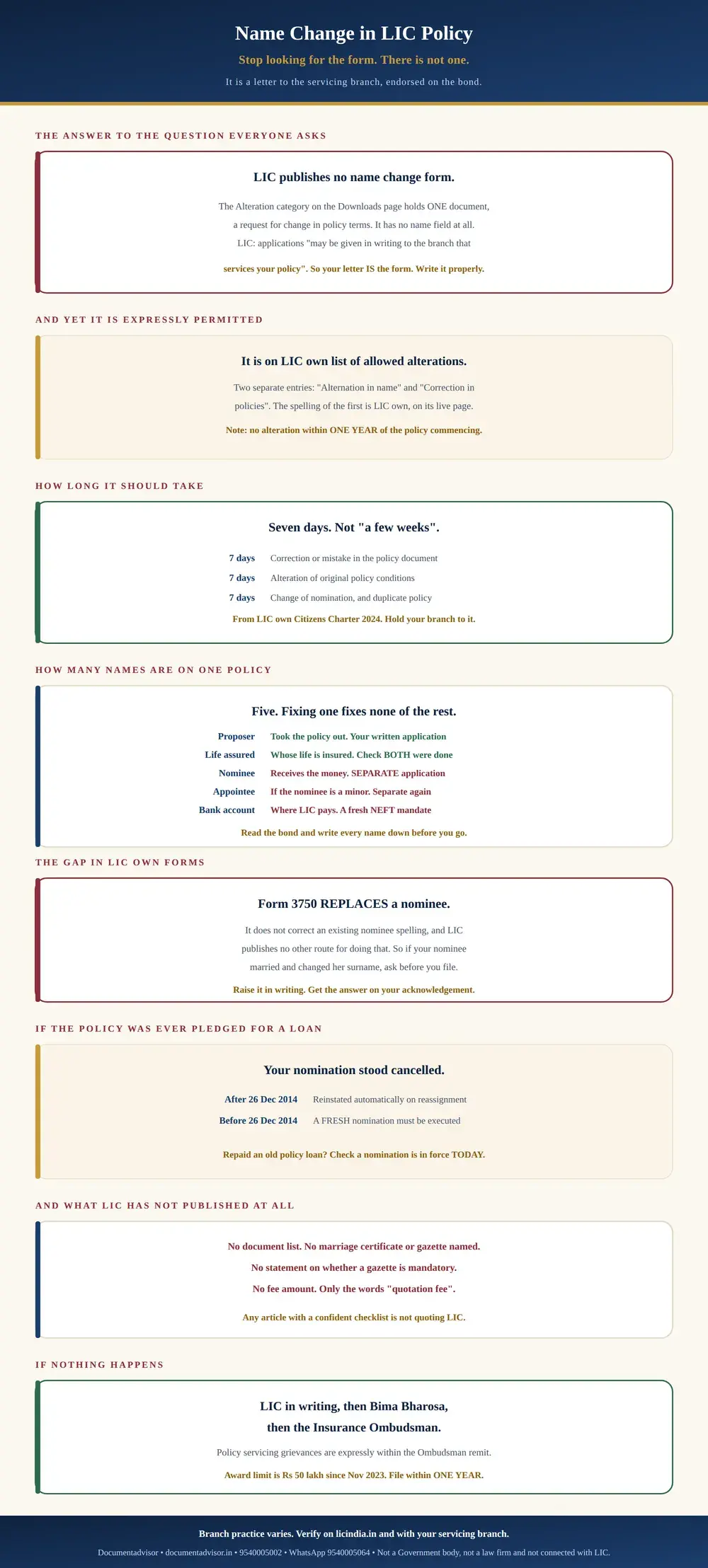
- How long. The Citizens Charter 2024 gives 7 days for a correction to the policy document, 7 days for a change of nomination or assignment, and 7 days for an alteration of original policy conditions.
- The fee. LIC publishes one sentence and no number: a “quotation fee” is charged for the change or alteration, and “no additional fee is charged for giving effect to the alteration”.
- The assignment rule, with its date. LIC: “On assignment (other than to LIC), Nomination automatically stands cancelled.” After 26/12/2014 it is reinstated on reassignment. Before that date, “fresh nomination will have to be executed”.
- And a correction to the regulator's own page. The Insurance Ombudsman's award limit was raised to Rs 50 lakh in November 2023. A widely read Government page still says Rs 30 lakh.
Who actually discovers a name mismatch on a policy?
Not you. And that is the honest reason to deal with it now.
A rejected Aadhaar update, a delayed passport, a loan held up at a bank: those are problems you run into, on a working day, with time to sort them out. A policy is not like that. Whatever was written into the record when the policy was taken is what sits there, quietly, for twenty or thirty years, and the person who eventually has to reconcile it with an identity document is usually somebody else.
We are not going to dress this up beyond that. A mismatch is not automatically a refusal, and nothing on this page should be read as saying a claim will fail. What it does is turn a straightforward payment into a documentary argument, at the point where a family least wants one. And the fix, while you are here to make it, takes an afternoon and a bus fare.
How many names does one LIC policy actually carry?
Up to five, in five different roles. Correcting one does nothing to the rest.
This is the part that surprises people, and it is the reason so many name changes are done half way and then discovered to be incomplete years later. A single policy is not one name on one line. It is a set of roles, and each role has its own entry, its own application and its own proof.
| Role | Who it is | Changed by |
|---|---|---|
| Proposer | The person who took out the policy and pays the premiums | A written name change application at the servicing branch |
| Life assured | In LIC's own glossary, “the person whose life is insured by an individual life policy”. Often but not always the proposer | The same application, but check both entries were corrected |
| Nominee | In LIC's glossary, the person the policyholder authorises to receive the policy moneys | A separate exercise. See the nominee section |
| Appointee | Where the nominee is a minor, the adult who receives on their behalf | Named in the nomination, on LIC's own appointee forms |
| Bank account holder | The account LIC actually pays into, set by the NEFT mandate | A fresh NEFT mandate, plus your bank's own record. See the NEFT section |
Which LIC form do you use for a name change?
None. And knowing that saves you a wasted trip and an argument at a counter.
LIC publishes no name change form. Its Downloads page has an Alteration category, and the only document in it is a request for change in policy terms, which covers premium frequency, reduction of term and reduction of sum insured. It has no name field at all. So the request is what LIC says it is: an application in writing to the servicing branch.
But the alteration itself is expressly allowed
This matters, because “there is no form” sounds like “LIC does not do this”, and that is wrong. LIC's policy conditions page sets out the alterations it permits during the lifetime of a policy, and the list includes both of these, in LIC's own wording:
Ask for it by the right name
At the counter, ask for an alteration. That is LIC's own vocabulary for this and it lands better than asking for a form that does not exist.
Two entries, not one
A correction fixes what was always meant to be your name. An alteration in name records that your name has genuinely changed. LIC lists them separately but publishes no explanation of the difference, so say which one yours is, in writing, and let the branch classify it.
One year rule, worth knowing
LIC's same page notes that no alteration is permitted within one year of the commencement of the policy, with some exceptions. If your policy is very new, ask before you assemble papers.
Can you change your LIC policy name at any branch or online?
No on both counts, and there is a physical reason for it.
LIC's own guidance on alterations is short and specific: “Your applications may be given in writing to the branch that services your policy for our further action.” That is the servicing branch, shown on your premium receipt and named on the first page of the policy document, and it is usually the branch where the policy was taken.
The bond is endorsed, not just the database
The correction is written onto the policy document itself. That is why the original bond has to travel with you. A policy is a contract, not a printout, and LIC still treats the paper as the record.
Which is why it is not an online service
LIC's customer portal and e-services do a great deal: policy schedule, status, bonus, loan status, claim status, revival quotation, premium certificates, even an image of your policy bond. A name change is not among them.
If policies are now electronic, why does the paper bond still matter?
Because the rule that made them electronic did not reach backwards.
The IRDAI (Protection of Policyholders' Interests, Operations and Allied Matters of Insurers) Regulations, 2024, notified on 20 March 2024 and in force from 1 April 2024, contain a provision that sounds as though it settles all of this: “Every insurer shall issue insurance policies only in electronic form”, with a physical document also issued where the policyholder asks for one.
What an e-Insurance Account is
The same regulations define an e-Insurance Account as an electronic account for maintaining policies issued electronically, and an e-Insurance Policy as a digitally signed policy document issued in electronic form. Newer policies may sit in one.
And what that means for a name change
Ask your insurer whether a policy is held in an account with a repository, because a record held there may need its own attention. We have not found a published statement on how a name correction propagates between the two, so we will not tell you that it does.
How do you change your name in an LIC policy, step by step?
Seven steps, and the first two happen at home before you go anywhere.
Read the bond and list every name
Proposer, life assured, nominee, appointee. Write down the exact spelling of each, and the policy number and servicing branch while you are there. Do this for every policy you hold, since older ones may sit at different branches.
Decide which entry you are changing
Your own name, the nominee's, or both. They are different requests, and the nominee's has its own route described in the section below. Deciding this at home stops you making two trips.
Write the application
There is no form, so the letter is the form. Policy numbers, the name on record, the exact new name, the role it sits in, the enclosures, and a request for an acknowledgement. Address it to the Branch Manager of the servicing branch.
Attach the proof that links the two names
A State Government marriage certificate, a certified divorce decree, or a gazette notification, with an identity document in the new name and, where asked, the old one. LIC publishes no list, so confirm with your branch and take the full set rather than the minimum.
Take originals and the policy bond
Photocopies for the file, originals for verification, and the original bond for the endorsement. Without the bond the branch cannot complete the job however good your paperwork is.
Get the acknowledgement before you leave
With a reference and a date. That is what starts the seven day clock in LIC's Citizens Charter, and it is what a grievance needs if nothing happens.
Collect the endorsed bond and check it
Read the endorsement against your document, letter for letter, before you leave the counter with it. An endorsement carrying a new spelling error is worse than the original problem, because it looks settled.
Then close the loop on the other names
The nominee's entry, and a fresh NEFT mandate once your bank record carries the new name. Those are the two people forget, and they are the two that matter at claim time.
Does your old identity document still work for LIC?
The same rule that protects you at a bank counter reaches insurers too, and almost nobody makes the connection.
The Prevention of Money-laundering (Maintenance of Records) Rules, 2005 carry an explanation, inserted in 2015, in the definition of an officially valid document:
Most writing about that rule treats it as a banking rule, because the Reserve Bank circulated it to banks. But the rule sits in the PMLA rules, not in a banking regulation, and it binds every reporting entity. Under the Prevention of Money Laundering Act a reporting entity includes financial institutions and intermediaries, and India's Financial Intelligence Unit publishes reporting formats for insurance companies as a reporting entity sector. Insurers are inside the same definition.
What that means at the counter
Your identity document in the former name does not stop being valid merely because your name has changed, provided you produce a State Government marriage certificate or a gazette notification with it. That is the same combination the bank accepts.
And the CKYC provision goes further
Rule 9 requires a reporting entity to seek your KYC Identifier and obtain records from the Central KYC Records Registry, and states it “shall not require a client to submit the same KYC records or information or any other additional identification documents”. That is an obligation on them, not a favour to you.
Does changing your name change the nominee's name?
No. And there is a gap in LIC's own forms here that is worth knowing about.
Nomination is, in LIC's words, “a right conferred on the holder of a Policy of Life Assurance on his own life to appoint a person or persons to receive policy moneys in the event of the policy becoming a claim by the assured's death”. It is a separate instruction, and correcting your own entry does nothing to it.
The forms LIC actually publishes
Form 3750, notice of change of nomination. Form 3751, cancellation. Form 3264, nomination. Form 3265 where the nominee is a minor. All downloadable, all going to the servicing office.
You do not need the nominee's consent
LIC states it plainly: a nomination “may be changed or cancelled by the life assured whenever he likes without the consent of the Nominee”. They need not agree, and need not be told.
It is effective only when registered
Form 3750 is a notice to LIC, and the change takes effect when LIC receives and registers it and endorses the bond. An intention noted at home counts for nothing.
What happens to your nomination if the policy was assigned for a loan?
It was cancelled. And whether it came back depends on a date in December 2014.
Policies are routinely assigned as security for a loan, and this is one of the few places where LIC publishes a rule that is precise, dated and consequential. Assignment, in LIC's words, “means transfer of rights, title and interest”, and the assignee becomes the owner of the policy.
Assigned after 26 December 2014
LIC: once the policy is reassigned, “the nomination which was present before the assignment of the policy, will get reinstated automatically”. Nothing further to do, though it is still worth confirming.
Assigned before 26 December 2014
LIC: “fresh nomination will have to be executed”. It does not come back on its own, and nobody writes to tell you.
Does LIC need your new bank account name too?
Yes, and this is where the policy chain joins the bank chain.
LIC pays maturity, survival benefit and death claims directly into a bank account by NEFT. Which account, and in whose name, is set by a NEFT mandate form, and that form asks for the name of the policyholder or claimant together with a cancelled cheque leaf or, where the cheque does not carry the account holder's name, a photocopy of the passbook page that does.
Which order to do these in
Bank first, then LIC. Under the rule described above, your old identity document remains valid at the bank when supported by the marriage certificate or gazette, so the bank does not have to wait for anything. Once the bank record carries the new name, you have a cheque or passbook page that matches, and the LIC mandate becomes straightforward.
Check the cheque actually shows your name
Many printed cheque leaves do not. That is exactly why the mandate form allows the passbook page instead. Look before you go, so that you are not sent back for a document you could have brought.
What does an LIC name change cost, and how long does it take?
Seven days by LIC's own charter. The cost is the one thing LIC has not put a number on.
| Item | LIC's published position |
|---|---|
| Correction or mistake in the policy document | 7 days |
| Alteration of original policy conditions | 7 days |
| Registration or change of nomination, and assignment | 7 days |
| Change of address, with KYC norms complied | 7 days |
| Issue of a duplicate policy | 7 days |
| Acknowledgement of a complaint | Same day |
| Action on a complaint and intimation of the decision | 14 days |
| The charge | LIC publishes a “quotation fee” for a change or alteration, and states that “no additional fee is charged for giving effect to the alteration”. No amount is published. Ask your branch |
What can you do if LIC does not act on your request?
There is a proper route, it is free, and it has a deadline attached to it.
1. The insurer first, in writing
A written representation to LIC. Its Citizens Charter promises acknowledgement of a complaint the same day and action with the decision intimated within 14 days. Grievances can be emailed to LIC's central complaints address.
2. Bima Bharosa, the regulator's portal
IRDAI's grievance portal states that a complaint “will be attended to within 14 days” and that the insurance company should resolve it within 15 days of receipt. Its grievance call centre numbers are 155255 and 1800 4254 732.
3. The Insurance Ombudsman
Under the Insurance Ombudsman Rules, 2017, notified as G.S.R. 413(E) on 25 April 2017. The heads of complaint expressly include “policy servicing related grievances against insurers”, which is exactly what an ignored name change is.
What are the common mistakes on an LIC name change?
Eight, and most of them are things left half done rather than done wrong.
Correcting your own name and stopping
The nominee's entry stays as it was, and that is the name that has to match a document when a claim is made. It is the single commonest miss on this page.
Going to a convenient branch
Alterations go to the branch that services the policy. Any other branch is a wasted morning, and it is the sort of thing nobody tells you until you are at the counter.
Turning up without the original bond
The change is endorsed on the document. No bond, no endorsement, however complete the rest of your file is.
Assuming a nomination survived an assignment
It did not. And for assignments before 26 December 2014 it never came back on its own. See the assignment section.
Updating the bank and forgetting the NEFT mandate
LIC pays into the account named on the mandate, not the account you think of as yours. A fresh mandate is a two minute job.
Holding several policies and doing one
Each policy is its own contract, its own bond and its own request, and older ones may sit at different branches.
Settling on a different spelling elsewhere
Then the LIC endorsement disagrees with your Aadhaar. Fix the exact wording once, at the start, and use it everywhere.
Not checking the endorsement before leaving
A new error written onto the bond looks settled, which makes it harder to argue about later. Read it at the counter.
Where does the LIC policy sit in the order of updates?
Near the end, and deliberately so, because it wants documents the earlier steps produce.
1. The linking document
A marriage certificate, a decree, or a gazette notification. Everything after this asks to see it.
2. Aadhaar
Which allows only two name changes in a lifetime. See our Aadhaar guide.
3. PAN
Which takes its data from Aadhaar on the paperless route. See our PAN guide.
4. Bank accounts
Or earlier, under the rule described above. See our bank records guide.
5. Passport
Which wants two documents already in the new name. See our passport guide.
6. Voter ID and driving licence
Free and about Rs 200 respectively. See our voter ID and driving licence guides.
7. LIC and other policies
Once the bank record is right, so the NEFT mandate matches. Then the nominee's entry.
8. Everything else
Employer, provident fund, investments, demat, property and utility records.
Where can we help with an LIC policy name change?
Across India, and on the document rather than on the branch visit.
All 28 states and 8 union territories
LIC's alteration practice is national, and the servicing branch is wherever your policy sits. The document that links your two names is the same everywhere.
The linking document, which is the real work
Whether your marriage certificate actually shows the name you want on the bond, or whether a gazette notification is the cleaner route for LIC, the bank and everybody else at once.
Preparing the gazette properly
Affidavit, newspaper notices, the proforma and the complete Central file. It goes to Civil Lines, Delhi 110054. See our gazette office in Delhi page.
What we will not charge you for
The branch visit is yours. The bond has to travel and LIC deals with the policyholder. We will say so rather than pretend otherwise.
What do the LIC terms on this page mean?
Twelve definitions, each written to stand on its own.
- Alteration
- LIC's own word for a change made to a policy after it has been issued. Its policy conditions page lists the alterations permitted, including alteration in name and correction in policies, and notes that no alteration is generally permitted within one year of the policy commencing.
- Policy bond
- The physical policy document, which is the evidence of the contract between insurer and insured. A name change is endorsed on it, so the original has to be produced, and every claim requirement in LIC's material begins with it.
- Endorsement
- A change written onto the policy document itself rather than recorded only in a database. Where there is not enough space on the bond, further paper may be attached so as to become an inseparable part of it.
- Servicing branch
- The LIC branch that administers a particular policy, shown on the premium receipt and on the first page of the policy document. Alterations are given in writing to this branch rather than to any convenient one.
- Proposer
- The person who takes out the policy and pays the premiums. Where a policy is taken on somebody else's life, the proposer and the life assured are different people with separate entries in the record.
- Life assured
- In LIC's glossary, the person whose life is insured by an individual life policy. A policy can therefore carry a proposer's name and a life assured's name that are not the same.
- Nominee
- The person the policyholder authorises to receive the policy moneys. A nomination may be changed or cancelled by the life assured at any time without the nominee's consent, and it takes effect only once LIC registers it.
- Appointee
- Where the nominee is a minor, the adult named to receive the policy moneys on the minor's behalf, with age, address and relationship recorded. It is a fourth name on the policy and it needs to be correct too.
- Assignment
- In LIC's words, the transfer of rights, title and interest in a policy, commonly used to give a lender security. On assignment to anybody other than LIC, an existing nomination automatically stands cancelled.
- NEFT mandate
- The instruction that tells LIC which bank account to pay maturity, survival benefit and death claims into. It carries the policyholder or claimant name and requires a cancelled cheque, or a passbook page where the cheque does not show the name.
- Reporting entity
- Under the Prevention of Money Laundering Act, an institution required to verify and record customer identity. Insurers fall within the definition, which is why the rule keeping an identity document valid after a change of name reaches them.
- Insurance Ombudsman
- An independent authority under the Insurance Ombudsman Rules, 2017 that decides complaints against insurers, including policy servicing grievances, subject to a prior written representation to the insurer and a one year filing limit.
Do you need help with an LIC name change?
With the branch visit, no, and we cannot do it for you anyway. With the document you take to it, quite possibly.
| Your situation | Do it yourself? | Why |
|---|---|---|
| Marriage certificate clearly shows the name you want | Yes | A letter, the bond and one visit |
| Divorce, with a certified decree recording the name | Yes | The decree links the two names on its own |
| The certificate does not show the combination you want | Advice helps | A gazette is usually the cleaner route, and it works for every institution at once |
| A first name or full name change | Advice helps | A gazette is genuinely needed to link the two names |
| A spelling in the bond that appears nowhere else | Ask first | If nothing you hold connects the two versions, a gazette may be the only route |
| The nominee's name needs correcting rather than replacing | Ask the branch | LIC publishes no form for this. Get the answer in writing |
Your Trust and Security First
Your documents stay private
Handled by our own desk in Burari, Delhi, used for your file and nothing else.
We read LIC's own pages, not other websites
The alteration list, the Citizens Charter timings and the assignment rule on this page all come from LIC's published material.
We say when something is not published
LIC gives no document list and no fee figure for a name change. We tell you that rather than inventing a checklist.
We settle the spelling once
Letter for letter, so that the policy bond, Aadhaar, PAN and the bank all end up saying the same thing.
We point at the entries people forget
The nominee, the appointee and the NEFT mandate. Those are the three that matter later.
We tell you when to keep your money
The branch visit is free and yours to make. If that is all you need, we will say so.
Everything You Need, In One Place
Reading your linking document
Whether the marriage certificate or decree actually establishes the name you want endorsed on the bond.
Settling the exact form of the name
Letter for letter and space for space, so every institution ends up with the identical version.
Full gazette file preparation
Affidavit, both newspaper notices, the proforma and the complete Central file, where the certificate will not do the job.
Drafting the application to the branch
Since LIC publishes no form, the letter is the form. We will draft it so that it is processed rather than returned.
Sequencing the whole set of records
Aadhaar, PAN, bank, passport, voter ID, licence and the policy, in the order that stops one office contradicting the next.
Telling you when to do it yourself
Which for the LIC visit is always. We would rather point at the branch than charge for a free service.
How It Works
Send us what you hold
The policy bond and the certificate you were planning to rely on. We tell you whether it will hold up.
We settle the name and the route
The exact spelling, and whether your certificate is enough or a gazette notification is the cleaner path.
You walk into the branch once
With a letter that will be processed, the right enclosures and the bond. One visit rather than three.
The questions people search about an LIC name change
Which form is used for a name change in an LIC policy?
There is not one. LIC's Downloads page has an Alteration category, and the only document in it is a request for a change in policy terms covering premium frequency, term and sum insured. It has no name field. LIC's own instruction for alterations is that applications “may be given in writing to the branch that services your policy”, so a properly drafted letter is the instrument.
Is a name change even allowed on an LIC policy?
Yes, expressly. LIC's policy conditions page lists the alterations it permits, and the list includes both alteration in name and correction in policies as separate entries. The same page notes that no alteration is generally permitted within one year of the policy commencing, with some exceptions.
How long does LIC take to change a name?
LIC's Citizens Charter 2024 gives seven days for a post policy service request concerning a mistake or correction in the policy document, and seven days for an alteration of original policy conditions. There is no row that says “name change”, so a name change falls under one of those two. Seven days is the published expectation, not the few weeks that circulates online.
Can an LIC name change be done online?
No. LIC's e-services do a great deal, including policy status, bonus, loan status, claim status, premium certificates and even an image of the policy bond, but a name change is not among them. The change is endorsed on the original bond, which is why the document has to be produced at the branch.
What documents does LIC want for a name change?
LIC does not publish a list. No LIC page names a marriage certificate, a gazette notification, an affidavit or a court order for this purpose. In practice you take the document that links your old name to your new one, an identity document in the new name, originals for verification and the policy bond. Confirm with your servicing branch, and be suspicious of any article that gives you a confident list, because it is not quoting LIC.
Does changing my name change my nominee's name?
No. They are separate entries. Worse, Form 3750 is a notice of change of nomination, built to replace one nominee with another, and it does not provide for correcting an existing nominee's spelling. If that is what you need, raise it at the servicing branch in writing and get the answer on your acknowledgement.
What happens to a nomination if the policy was assigned for a loan?
LIC states it plainly: “On assignment (other than to LIC), Nomination automatically stands cancelled.” For assignments after 26 December 2014 the earlier nomination is reinstated automatically on reassignment. For assignments before that date, “fresh nomination will have to be executed”. If you repaid an old policy loan years ago, check whether a nomination is actually in force.
What if LIC does not act on the request?
Written complaint to LIC first, which its charter says will be acknowledged the same day with the decision intimated within 14 days. Then IRDAI's Bima Bharosa portal, which states a complaint will be attended to within 14 days, on 155255 or 1800 4254 732. Then the Insurance Ombudsman, whose heads of complaint include policy servicing grievances, subject to a prior written representation and a one year filing limit.
Check the document before you go to the branch
Talk to the desk
Phone: 9540005002
WhatsApp: 9540005064
Email: support@documentadvisor.in
Hours: Monday to Saturday, 9 AM to 6 PM
Office: Near Hanuman Mandir, Metro Pillar No. 376, Near Burari Metro Station, Shop No. 2nd Ground Floor, Gali No. 1, Plot No. 31/12, Hardev Nagar, Jharoda Majra, Burari, Delhi 110084
Frequently asked questions
Which LIC form do I use for a name change?
None. LIC publishes no name change form. Its Downloads page has an Alteration category, and the only item in it is a request for change in policy terms covering premium frequency, term and sum insured, with no name field. LIC's instruction for alterations is that applications may be given in writing to the branch that services your policy, so a properly drafted letter is the instrument.
Is a name change actually permitted on an LIC policy?
Yes. LIC's policy conditions page lists the alterations it allows during the lifetime of a policy, and the list includes alteration in name and correction in policies as two separate entries. The same page notes that no alteration is generally permitted within one year of the policy commencing, with some exceptions.
How long should it take?
LIC's Citizens Charter 2024 gives seven days for a post policy service request concerning a mistake or correction in the policy document, and seven days for an alteration of original policy conditions. A name change falls under one of the two, and LIC does not say which. Either way seven days is the published expectation.
Can I do it online or at any branch?
No to both. It is not among LIC's e-services, and LIC's own wording directs alteration applications to the branch that services your policy, which is shown on your premium receipt and on the first page of the policy document. The change is endorsed on the original bond, which is why the document has to be produced in person.
What documents does LIC require?
LIC publishes no document list for a name change. In practice you take the document that links your old name to your new one, being a State Government marriage certificate, a certified divorce decree or a gazette notification, together with an identity document in the new name, originals for verification and the policy bond. Confirm the exact set with your servicing branch.
Do I have to take the original policy bond?
Yes. The change is endorsed on the policy document itself rather than recorded only in a database, so the original has to be produced. Where there is not enough space on the bond for an endorsement, additional paper may be attached so that it becomes an inseparable part of the bond.
What if the policy bond is lost?
Deal with that first. LIC's guidance is that loss of the policy document should be immediately intimated to the branch office where it is serviced, and there is a duplicate policy procedure with its own forms. The Citizens Charter allows seven days for issuing a duplicate policy. You cannot get an endorsement onto a document you do not have.
What does it cost?
LIC publishes one sentence and no figure: a fee for the change or alteration is charged, called a quotation fee, and no additional fee is charged for giving effect to the alteration. No amount appears on any LIC page. Ask your servicing branch, and treat any article quoting a rupee figure with caution because it is not quoting LIC.
Does my nominee's name change with mine?
No. It is a separate entry. And there is a gap worth knowing: Form 3750 is a notice of change of nomination, built to replace one nominee with another, and it does not provide for correcting an existing nominee's spelling. Raise a correction at the servicing branch in writing and get the answer on your acknowledgement.
Does the nominee have to consent, or even know?
No. LIC states that a nomination may be changed or cancelled by the life assured whenever he likes without the consent of the nominee. The change takes effect only once LIC receives and registers it and the bond is endorsed, so an intention noted at home has no effect at all.
My policy was assigned for a loan years ago. Does that matter?
Very possibly. LIC states that on assignment other than to LIC, nomination automatically stands cancelled. For assignments after 26 December 2014 the earlier nomination is reinstated automatically on reassignment, but for assignments before that date a fresh nomination has to be executed. Check whether a nomination is actually in force.
Do I need to tell LIC about my new bank account name?
Yes. LIC pays maturity, survival benefit and death claims by NEFT into the account named on the mandate form, which asks for the policyholder or claimant name with a cancelled cheque, or a passbook page where the cheque does not carry the name. Submit a fresh mandate once your bank has updated its own record.
Should I do the bank or LIC first?
The bank. Under an amendment to the Prevention of Money-laundering (Maintenance of Records) Rules, 2005, an identity document remains officially valid despite a later change of name when supported by a State Government marriage certificate or a gazette notification, so the bank need not wait. Then bring the matching cheque or passbook page to LIC with the NEFT mandate.
Does that rule apply to insurers at all?
The rule sits in the money laundering rules rather than in a banking regulation, and it binds every reporting entity. Insurers fall within that definition, and India's Financial Intelligence Unit publishes reporting formats for insurance companies as a reporting entity sector. It governs identification and KYC rather than how a contract is endorsed, but it removes the argument that everything else must be reissued first.
I hold several LIC policies. Is one request enough?
No. Each policy is its own contract with its own bond and its own request, and older policies are frequently serviced by different branches. LIC does allow policy records to be transferred from one branch office to another on request, provided the policy is in force, which is worth doing if you hold several.
What can I do if nothing happens?
A written complaint to LIC first, acknowledged the same day with the decision intimated within 14 days under its charter. Then IRDAI's Bima Bharosa portal, on 155255 or 1800 4254 732. Then the Insurance Ombudsman, whose heads of complaint include policy servicing grievances, after a written representation to the insurer and within one year.
How much can the Insurance Ombudsman award?
Up to Rs 50 lakh. The limit was raised from Rs 30 lakh by the Insurance Ombudsman (Amendment) Rules, 2023, notified as G.S.R. 828(E) on 9 November 2023. Note that at the time of writing a well known official policyholder information page still states the older Rs 30 lakh figure, so check the amendment rules rather than the page.
Does my policy number change?
No. This is an alteration to an existing contract, not a new policy. The policy number, the commencement date, the sum assured and the premium are unaffected. What changes is the name recorded against the policy, and the endorsement is written onto the bond you already hold.
What will my family actually need at claim time?
The original policy bond in every case. For a maturity or survival benefit claim the servicing branch also asks for a discharge form and a NEFT mandate with bank account details, and sends intimation in advance. For a death claim the nominee intimates the servicing branch in writing with the policy number, the name of the policyholder and the date and cause of death.
Is there anything free worth arranging while I am at it?
Ask about successive nominees, so that if something happens to the first nominee and the life assured together, the next nomination takes effect without anybody having to prove anything. And write down where the policy bond is kept, which branch services it and the policy numbers, then tell one other person.
Where can you verify all of this yourself?
Open the second one and read the alterations list. It settles the first half of this page.
- Life Insurance Corporation of IndiaThe official site. Branch locator, forms and policy servicing information, and the source for everything on this page attributed to LIC.
- LIC policy conditions, the alterations listWhere alteration in name and correction in policies appear as permitted alterations, and where the one year restriction is stated.
- LIC policy guidelines for policyholdersThe instruction that applications may be given in writing to the branch that services your policy.
- LIC, help us to serve you betterNomination and assignment, including that nomination stands cancelled on assignment and the 26 December 2014 distinction, and what to do if the policy document is lost.
- LIC Citizens CharterThe seven day turnaround for a correction to a policy document, for an alteration and for a change of nomination, and the complaint timings.
- LIC Downloads, formsThe Alteration category with no name change form, and the nomination forms including Form 3750 and the NEFT mandate.
- LIC contact and helplineThe call centre, WhatsApp and SMS services, Customer Zone hours and the grievance email address.
- Prevention of Money-laundering (Maintenance of Records) Rules, 2005Rule 2, the explanation keeping a document officially valid after a change of name, and Rule 9 on the Central KYC Records Registry and the KYC Identifier.
- Bima Bharosa, the IRDAI grievance portalWhere a complaint against an insurer is registered, with the published timelines and the grievance call centre numbers.
- Council for Insurance OmbudsmenThe Insurance Ombudsman Rules, 2017 and the 2023 amendment raising the award limit to Rs 50 lakh.
- Documentadvisor: Affidavit for Name ChangeThe affidavit format this record update is built on: who can attest it, and what it should say.
- Documentadvisor: Name Change in EPFO and UANUpdating your name in EPFO records and UAN.
- Documentadvisor: Name Change in Property DocumentsUpdating property records, sale deeds and registry documents.
In short
Everything on this page in twelve lines
- There is no LIC name change form. LIC's own instruction is that alteration applications are given in writing to the branch that services your policy, so your letter is the form.
- The alteration itself is expressly allowed: LIC's policy conditions page lists alteration in name and correction in policies as two separate permitted alterations.
- Seven days, in LIC's Citizens Charter 2024, for a correction to a policy document or an alteration of original policy conditions. Not the few weeks you will read elsewhere.
- The change is endorsed on the original policy bond, so the document travels with you and it is not an online service.
- Read the bond first and list every name on it. One policy can carry a proposer, a life assured, a nominee, an appointee and a bank account holder.
- Correcting your own name does nothing to the nominee's entry, and that is the name matched against a document when a claim is made.
- And Form 3750 replaces a nominee rather than correcting one's spelling. If you need a correction, raise it in writing and get the answer on your acknowledgement.
- If the policy was ever assigned for a loan, the nomination stood cancelled. After 26 December 2014 it revives on reassignment; before that date it does not.
- Submit a fresh NEFT mandate once your bank record carries the new name, because that is the account LIC actually pays into.
- LIC publishes no document list and no fee figure. It states only that a quotation fee is charged and no additional fee for giving effect to the alteration.
- The same money laundering rule that keeps your old identity document valid at a bank reaches insurers, because they are reporting entities too.
- If nothing happens: LIC in writing, then Bima Bharosa, then the Insurance Ombudsman, who can award up to Rs 50 lakh and must be approached within a year.
Send us the certificate before you go to the branch.
Tell us the name you want on the bond and send a photograph of your marriage certificate, decree or gazette. We will tell you whether that document actually links the two names, or whether it shows both and still not the version you want, which is the commonest way this fails at a counter. If a gazette notification would be cleaner we will prepare it properly, since it is one of only two documents the money laundering rules name for this purpose. The branch visit itself is free and yours to make, and we will say so rather than invoice you for it.