How to Change Name Legally in India
Nearly every guide gives you the same three steps and implies they work identically everywhere. They do not. In Goa the law is a state Act of 1990 and the file goes to the Registrar who holds your birth record. In Tamil Nadu the state proforma is issued free of cost and the state route asks for no newspaper advertisement at all. The Central Gazette does not publish date of birth changes; Maharashtra and Gujarat do. This page is the process, and the places where the process is not the process.
How to Name Change in India | Gazette of India | Gazette Office | Name Correction | Change of Name
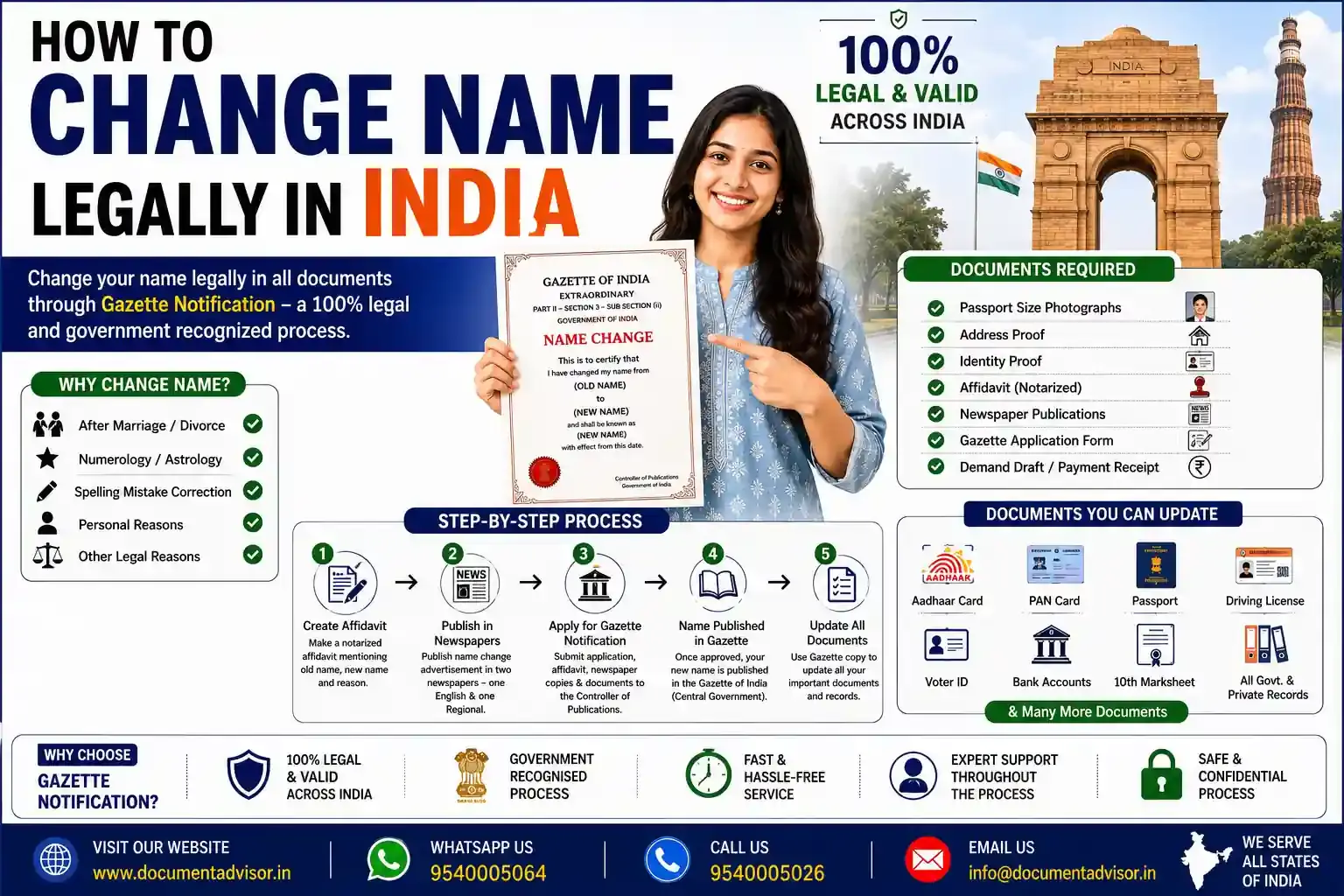
To change your name legally in India, make a notarised affidavit stating your old name, new name and reason, publish the change in a daily newspaper, then apply for a gazette notification, either to the Central Gazette through the Department of Publication in Delhi or through your state's own route where one exists. The Central fee is commonly Rs 1,100 for adults and Rs 1,700 for minors, paid only on BharatKosh, and publication takes about 30 to 45 days.
What does changing your name legally in India actually involve?
Three stages, in a fixed order. An affidavit that sets the exact new name down and swears it. A newspaper advertisement that puts it in public so anyone with an objection can see it. And a gazette notification, which is the stage that makes it official. The first two are groundwork. The third is the record every institution later asks to see.
A Gazette notification is a formal announcement of your name change printed in the official journal of a Government. Once it carries a date and an entry number, passport offices, UIDAI, banks, boards, PSUs, employers and foreign missions treat it as the legal record of your new name. An affidavit on its own is the beginning of the change, not the end of it, and no court order is involved at any point.
What almost no guide tells you is the part that decides your cost, your timeline and sometimes whether your file works at all: which route applies to you. Roughly half the states run a usable gazette route of their own, and they are not variations on a theme. They differ in law, in cost, in language, in what they will publish, and in who is allowed to apply.
At a glance
- The three stages
- Notarised affidavit, then newspaper advertisement, then gazette notification
- The Central office
- Department of Publication, Civil Lines, behind Delhi Vidhan Sabha Metro Station, Delhi 110054. There is exactly one
- Whose office it is
- A subordinate office of the Ministry of Housing and Urban Affairs, headed by the Controller of Publications
- Which part publishes it
- Part IV of the Gazette of India, which carries notices from private people. Part IV belongs to the Central Gazette only
- Government fee
- Commonly Rs 1,100 adult, Rs 1,700 minor, Rs 3,500 adult from abroad and Rs 5,100 minor from abroad, on BharatKosh only, revised each financial year
- Newspapers
- The guidelines ask for one advertisement in a daily local leading newspaper. Two, one local and one national, is the common filing practice
- Who may apply
- The applicant, personally or by post or courier. Agents, advocates and other channels are not permissible
- Document age
- Supporting documents must not be older than one year
- Online application
- There is none for the Central Gazette. Several states do run genuine online state applications
- Where to download
- egazette.gov.in, free. Hard copies ceased on 1 October 2015
- Time
- About 3 to 7 weeks in total. There is no expedited or tatkal option on any route
- Date of birth
- The Central Gazette does not publish date of birth changes at all. Some state routes do
Key takeaways
- Three stages, and the gazette is the one that counts. The affidavit and the advertisement are groundwork; the notification is the record institutions accept.
- There is exactly one Central Gazette office, the Department of Publication at Civil Lines, behind Delhi Vidhan Sabha Metro Station, Delhi 110054. Any other city quoting pin 110054 has copied a fake address.
- Central fees are commonly Rs 1,100 adult and Rs 1,700 minor, and Rs 3,500 and Rs 5,100 for Indians applying from abroad, on bharatkosh.gov.in only. The Department revises these each financial year, so confirm before paying. They are not refundable.
- The published Rs 250 extra is a specific case, not a general surcharge: it applies where a person adopts the name or surname of another religion without changing their own religion, making Rs 1,350 with an undertaking.
- Roughly half the states run a route of their own, and they differ in law, cost, language and what they will publish. Several publish for Government employees only.
- The Central Gazette does not publish date of birth changes. If that is your problem, a Central application will not help you.
- Hard copies ceased on 1 October 2015. You download the PDF free from egazette.gov.in and it needs no certification. Nobody couriers you an original.
- Applications are entertained from the applicant only, personally or by post or courier. Agents and advocates are named as impermissible channels.
- A birth certificate error is a Registrar correction under Section 15 of the Registration of Births and Deaths Act, 1969, not a gazette matter.
- You do not need a court order, and India does not use the British deed poll system, so any checklist asking for a deed poll is importing foreign procedure.
What does almost every guide on this subject get wrong?
It describes one national process. For a majority of applicants that description is right. Presented as the whole picture, it causes real losses.
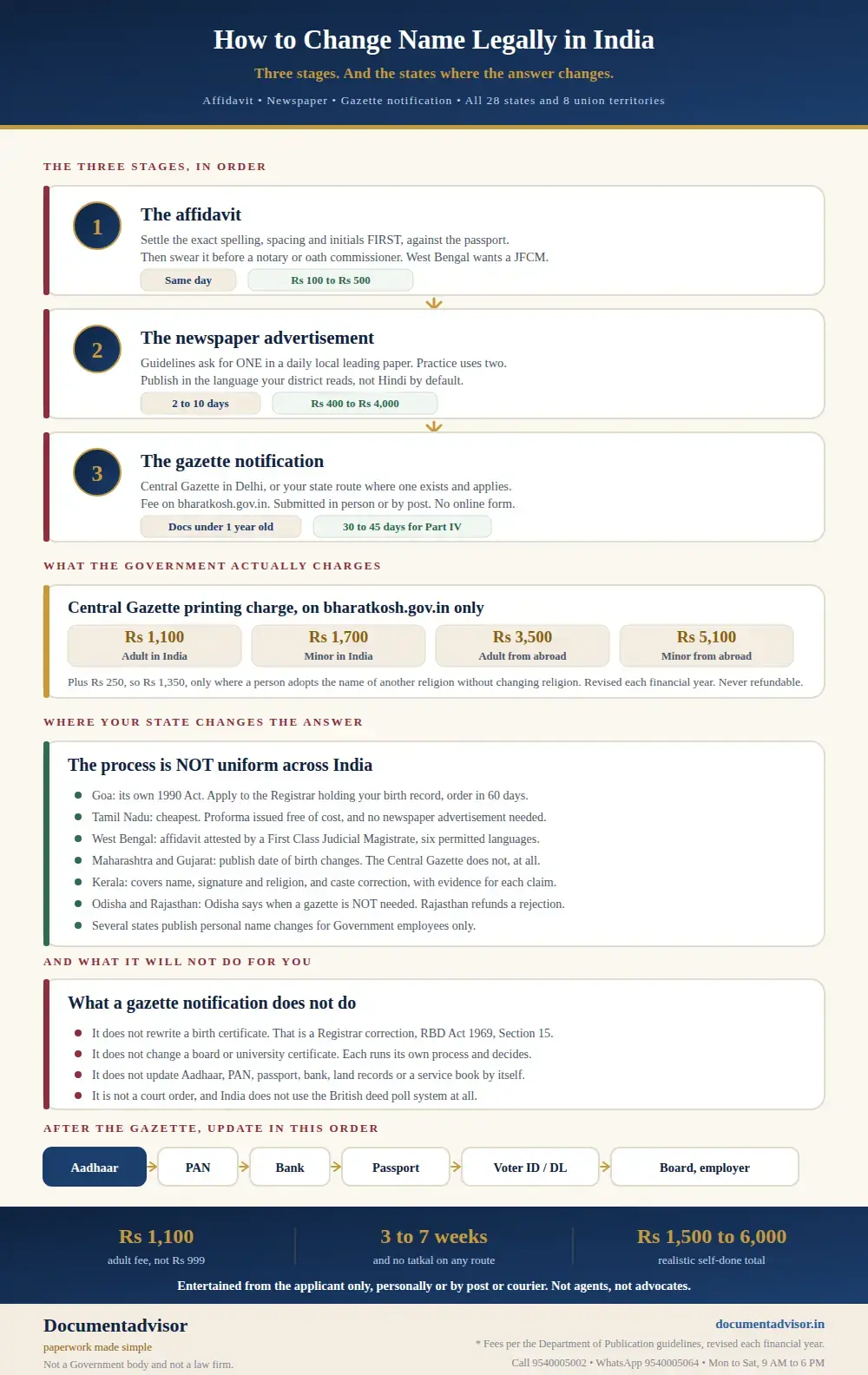
A reader in one state follows instructions written for another, and finds out several weeks later that the file was never going to work. The fee is not refundable and the time is not returnable, so this is an expensive way to learn. Here is a sample of what actually varies, each of these taken from that state's own Government material:
Goa has its own statute
The Goa Change of Name and Surname Act, 1990 governs it. If your birth is recorded in Goa, you apply on a prescribed form to the Registrar of the jurisdiction in which your birth is recorded. The Registrar publishes the notice in the Official Gazette calling for objections within thirty days, holds an enquiry where objections come in, and must pass an order within sixty days of receiving the application. An appeal lies to the Chief Registrar within thirty days, and that order is final. Newspaper advertisements and a Delhi file are not the route.
Tamil Nadu is the cheapest in India
The state publishes change of name notices on a proforma issued free of cost by the Stationery and Printing Department, and the state route does not require a prior newspaper advertisement at all. For a person whose records are all inside Tamil Nadu, the cost difference against the Central route is large.
West Bengal wants a different affidavit
Its Part II route requires the affidavit to be attested by a First Class Judicial Magistrate, not merely notarised, and the advertisement must appear in one of six permitted languages. The route is also limited to applicants aged eighteen and above, which pushes minors there to the Central Gazette.
Maharashtra and Gujarat publish date of birth changes
Both run online state services covering it. The Central Gazette does not publish date of birth changes at all. So for that one correction the state route is the only gazette option, and a Central application is money spent on a service the Department does not provide.
Kerala publishes more than names
Its private advertisement route covers change of name, signature and religion, and correction of caste, and it requires documentary evidence for every claim made in the notice. A blanket claim with nothing behind it does not get published.
Odisha tells you when not to bother
Its e-Gazette portal advises applicants not to apply for gazette publication for several common Aadhaar name updates, because under the UIDAI standard operating procedure a gazette is not required for them. A Government portal telling you to keep your money is worth more than most advice in this niche.
Rajasthan refunds a rejected application
Its ReAMS portal states that the amount is refunded if the application is rejected. The Central fee is not refundable in any circumstance, so this is a genuine structural difference rather than a detail.
Assam asks for one newspaper, not two
The state's own published procedure asks for an advertisement in any national or regional daily, singular, with the original copy submitted. Anyone applying the standard two advertisement habit there is paying for a second advertisement the state did not ask for.
The practical rule that falls out of all this
Before you spend anything, answer two questions.
Where is my birth recorded?
This decides whether a state route is even available to you. A few state routes, Goa's being the clearest, are built around the birth register rather than around where you live now.
Where does my new name have to work?
This decides whether a state notification is enough. If the answer involves a passport, a central Government job, a bank in another state or anything abroad, the Gazette of India is what those offices look for, and it is valid everywhere.
How do you change your name legally in India, step by step?
Three stages. The first one is a decision rather than a form, and it is the one people rush.
The affidavit
Old name, new name, parentage, address and reason, sworn before a notary or oath commissioner.
The newspaper advertisement
A public notice in a daily people in your district actually read, worded exactly as the affidavit reads.
The gazette notification
The file to the Central Gazette or to your state route, with the fee paid, then publication.
Stage one: the affidavit
An affidavit on stamp paper stating your existing name, the new name you are adopting, your father's or husband's name, your address and a clear reason for the change. It is sworn before a notary or oath commissioner in most states, though West Bengal's state route requires attestation by a First Class Judicial Magistrate and some states accept an Executive Magistrate. Stamp paper and notary together usually cost Rs 100 to Rs 500, and stamp paper values vary considerably by state.
Stage two: the newspaper advertisement
The advertisement is a public notice, so that anyone with an objection has a chance to see it. It carries your old name, new name, address, age, parentage and the affidavit date, worded exactly as the affidavit reads.
On how many, be aware of two things. The published guidelines for a simple adult name change ask for one recent advertisement in a daily local leading newspaper, with no language restriction stated. In actual filing practice two are commonly used, one local and one national, and that is the safer approach for a file that has to satisfy several institutions later. Neither position is wrong, and a service telling you two is not misleading you.
Language is where copied guides do real damage. A great many pages tell readers to publish in "the regional language, Hindi" regardless of the state. That is correct in the Hindi speaking states and wrong elsewhere: Punjabi in Punjab, Assamese in most of Assam with Bengali in the Barak Valley, Urdu alongside English in Jammu and Kashmir, English with Khasi or Garo in Meghalaya, Manipuri in Manipur, Nepali in Sikkim, Mizo or English in Mizoram, and Telugu, Tamil, Kannada, Malayalam, Marathi, Gujarati, Odia and Bengali in their respective states. Publishing in a paper nobody in your district reads satisfies the letter of the requirement and defeats its purpose.
Stage three: the gazette notification
This is the stage that makes the change official. For the Central route the file goes to the Department of Publication and your notification appears in Part IV of the Gazette of India, about 30 to 45 days after the file reaches Delhi. For a state route it goes to that state's Government press or printing and stationery department, on that state's form and at that state's fee.
Where is the gazette office in India?
Gazette Office in India | Address of Gazette Office India
What documents are required for a name change in India?
This is the Central Gazette list. State routes ask for their own set, usually shorter.
Per the Department of Publication's published guidelines, your file should contain:
- The original newspaper page or pages carrying your notice, with the date visible
- A signed undertaking showing your old and new name with father's or husband's name and residential address, declaring the facts are true
- Two copies of the prescribed proforma, computer typed and not handwritten, signed and attested, with the details of two witnesses
- A soft copy of the notice text in MS Word, without the witness portion. For an adult the guidelines say to type the old name in place of the signature; for a minor, the guardian's name
- A certificate signed by you declaring that the hard copy and the soft copy contents are similar
- Self-attested photocopy of identity proof of the applicant and of each witness
- Two self-attested passport size photographs
- Proof of the BharatKosh payment
- A request letter addressed to the Controller of Publications listing what the envelope contains
- The birth certificate where the applicant is a minor
- The marriage certificate or divorce decree where the change follows a marriage or a separation
- For applicants abroad, the deed attested by the Indian Embassy or High Commission of the country you are in
- For Central Government employees, the deed executed under the Ministry of Home Affairs Office Memorandum routed through the department
How much does it cost to change your name in India?
The Government charge is one line. The total is several, and the honest range is wide.
| Expense | Typical amount | Notes |
|---|---|---|
| Stamp paper and notary | Rs 100 to Rs 500 | Varies by state; some states use low denomination stamp paper |
| Newspaper advertisement | Rs 400 to Rs 4,000 | One advertisement or two, depending on route and practice. Compare quotes, rates vary a lot |
| Central Gazette fee, adult | Commonly Rs 1,100 | BharatKosh only, revised each financial year |
| Central Gazette fee, minor | Commonly Rs 1,700 | BharatKosh only, applied for by a parent or guardian |
| Central Gazette fee, adult applying from abroad | Commonly Rs 3,500 | The Government charge only. Attestation and courier are separate |
| Central Gazette fee, minor applying from abroad | Commonly Rs 5,100 | The Government charge only |
| Name or surname of another religion, religion unchanged | Rs 1,100 plus Rs 250, so Rs 1,350 | A specific published case, with an undertaking. It is not a general surcharge |
| Embassy attestation, courier and incidentals from abroad | Varies, commonly Rs 4,000 to Rs 5,500 on top | Not a Government fee. Budget it separately rather than assuming one figure covers everything |
| State gazette charges | Varies widely | Tamil Nadu among the lowest, with a proforma issued free of cost. Several states publish their own fee schedules |
| Speed post to Delhi | Rs 50 to Rs 200 | Only if you are posting rather than submitting in person |
| Realistic self-done total | Rs 1,500 to Rs 6,000 | Depending on the route, the state and the newspapers chosen |
How long does a legal name change take in India?
About 3 to 7 weeks on the Central route. State routes vary, and some are faster.
Day 1 to 2
The exact name settled in writing against the passport and board certificate, then the affidavit drafted and sworn.
Day 2 to 10
Advertisement booked and published. Each paper runs its own schedule, so allow a few days, longer in smaller towns.
Day 10 to 14
File prepared: proforma typed in duplicate, witnesses signed, soft copy and certificate ready, fee paid on BharatKosh.
Then 30 to 45 days
Publication in Part IV after the file reaches the Department. Add a few days each way if you are posting it.
Does your state have its own gazette route?
Use this as a starting point rather than a final answer. Departments change forms, fees and submission methods, so confirm before you travel or pay.
| State or region | Position on a state route | Worth knowing |
|---|---|---|
| Goa | Own statute | Goa Change of Name and Surname Act, 1990. Apply to the Registrar holding your birth record; notice published in the Official Gazette for objections within thirty days; order within sixty days; appeal to the Chief Registrar within thirty days |
| Tamil Nadu | Yes, and cheapest | Proforma issued free of cost by the Stationery and Printing Department. No prior newspaper advertisement required on the state route |
| West Bengal | Yes, Part II | Affidavit attested by a First Class Judicial Magistrate. Advertisement in one of six permitted languages. Applicants aged eighteen and above |
| Maharashtra | Yes, online | Filed through Aaple Sarkar. Also publishes date of birth and religion changes. Service standard and appeal route under the state right to service law |
| Gujarat | Yes, online | Change of Name and Surname service on the state e-Gazette, with a separate birth date change service. Publication fee not refundable |
| Kerala | Yes, private advertisement | Covers name, signature and religion changes and caste correction. Documentary evidence required for every claim |
| Odisha | Yes, online | Fee paid after approval. The portal advises when a gazette is not needed for Aadhaar updates. Government servants need a deed form and an office letter |
| Rajasthan | Yes, online | ReAMS portal. The amount is refunded if the application is rejected. Government employees submit a bond rather than the citizen's affidavit |
| Karnataka, Telangana, Andhra Pradesh | Yes | State gazettes run through their printing departments and e-gazette portals. Useful for state board, university and service records |
| Assam, Arunachal Pradesh, Mizoram | Yes | Assam asks for one advertisement in any national or regional daily. Arunachal and Mizoram publish personal changes as a deed in the state gazette |
| Himachal Pradesh | Yes, online | The HP Rajpatra is published online by the Printing and Stationery Department |
| Uttar Pradesh, Bihar, Madhya Pradesh, Jharkhand, Punjab, Haryana, Delhi and others | No practical citizen route | These state gazettes carry Government notifications. Personal name changes go to the Central Gazette |
| Jammu and Kashmir | No, since reorganisation | Personal name changes processed through the Central Gazette. Advertisement in English and Urdu |
| Sikkim, Meghalaya, Manipur, Nagaland, Tripura, Chhattisgarh | Check before assuming | Several have no citizen counter. Where a state gazette exists it may cover Government employees only |
Which states and union territories do we cover?
All of them. Each state guide below carries that state's own route, its own fee position and its own newspaper language, checked against that state's Government material rather than copied from this page.
The National Capital Region
Four cities, one office. Only the journey changes.
Call 9540005002, WhatsApp 9540005064, or write to support@documentadvisor.in. Monday to Saturday, 9 AM to 6 PM.
What do the name change terms actually mean?
The words that appear on every name change website, in language people actually use.
- Gazette notification
- A formal announcement printed in the official journal of a Government. For a name change it is what Aadhaar, PAN, passport offices, banks, boards, PSUs and employers accept as legal proof. It is not a court order and needs no lawyer.
- Gazette of India
- The Central Government's official journal, published by the Department of Publication. A notification here is valid in every state and is what foreign missions and central employers look for.
- State gazette
- A state Government's own official journal, run by its printing and stationery department. Useful and often cheaper for records inside that state, and in several states restricted to Government servants.
- Part IV
- The section of the Gazette of India carrying notices from private people rather than from Government. Part IV belongs to the Central Gazette only; a state gazette has its own parts and its own numbering.
- Department of Publication
- The Central Gazette office, at Civil Lines, behind Delhi Vidhan Sabha Metro Station, Delhi 110054, a subordinate office of the Ministry of Housing and Urban Affairs. There is exactly one of it.
- Controller of Publications
- The officer heading the Department, assisted by an Assistant Controller (Administration), an Assistant Controller (Business) and a Financial Officer. Your request letter is addressed to this officer.
- Affidavit
- A written statement you swear is true, signed before a notary or oath commissioner. It states the old name, the new name, parentage, address and the reason for the change. It is the start of the process, not the finish.
- Oath commissioner
- An advocate appointed to administer oaths and attest affidavits, found around district court complexes. For this purpose an affidavit sworn before a notary or an oath commissioner serves the same function.
- Deed of change of name
- The instrument a Government employee executes and routes through the department, so that the service book is updated alongside the gazette. Not the same thing as the British deed poll, which India does not use.
- Proforma
- The prescribed application format the Department requires, computer typed in duplicate and signed by you and two witnesses, whose self-attested identity proofs are enclosed with the file.
- Matching-contents certificate
- A short certificate signed by you declaring that the contents of the hard copy and the soft copy are similar. It is a listed requirement, not an optional extra.
- BharatKosh
- The Non-Tax Receipt Portal at bharatkosh.gov.in, the only accepted channel for the Central gazette fee. Demand drafts were discontinued.
- e-Gazette portal
- egazette.gov.in, where published Central issues are searched and downloaded free. It is an archive, not a place to file an application.
- Registrar correction
- A correction to a birth or death record under Section 15 of the Registration of Births and Deaths Act, 1969, through the body that registered it. Not a gazette matter.
- Alias
- A second name a person is also known by, published alongside the main name where the record needs both to appear. It is a publishing choice, not a separate legal status.
What do you update after the gazette, and in what order?
The order matters, because each office tends to ask for the one before it. Doing this backwards turns a four week job into a four month one.
| Order | Record | Why it comes here |
|---|---|---|
| 1 | Aadhaar | Almost everything else verifies against Aadhaar. Update it at an enrolment centre with the gazette PDF and your identity proof |
| 2 | PAN card | The correction form asks for proof, and an updated Aadhaar makes this straightforward |
| 3 | Bank accounts | Banks check the PAN and Aadhaar pair. Updating the bank first creates a mismatch you then have to undo |
| 4 | Passport | Re-issue with the change of name, once Aadhaar and PAN already carry it |
| 5 | Voter ID and driving licence | Straightforward once Aadhaar carries the new name |
| 6 | EPFO or UAN and insurance | Employer linked records. HR usually needs the notification and the updated Aadhaar together |
| 7 | School, board and university records | Including any in other states. Each board runs its own correction process and charges its own fee |
| 8 | Employer, property, GST and business records | Last, because these usually verify against the updated identity documents rather than the gazette alone |
Aadhaar rules are on uidai.gov.in and passport re-issue rules on passportindia.gov.in.
What does a gazette notification not do?
This is where most disappointment in this business comes from, so it is worth being blunt.
A gazette notification is a dated public record of your declaration. It is strong evidence and most institutions accept it. What it does not do is silently rewrite anything. Every one of these still runs its own process, with the gazette as the proof you bring:
School and board certificates
Each board has its own correction procedure, its own fee and its own decision.
Universities and degrees
The issuing university decides, on its own form and its own timeline.
Birth certificates
A Registrar correction under Section 15 of the RBD Act, 1969, through the body that registered the birth.
Land and revenue records
Through the relevant revenue office, which has its own mutation process.
Service books
Through your department, and for Central Government employees through the prescribed deed route.
Aadhaar, PAN, passport, bank
Each with its own update, in the order set out above.
How is a name changed in a school record?
How to Name Change in School Record in Bharat भारत में स्कूल रिकॉर्ड में नाम कैसे बदलें
Can a gazette correct a birth certificate?
No, and this is the most expensive misunderstanding on the page.
If the mistake is in a birth certificate, the fix is a Registrar correction under Section 15 of the Registration of Births and Deaths Act, 1969, through the body that registered the birth: the municipal corporation, the municipality, the panchayat or the cantonment board, depending on where it happened. The certificate itself names the issuing body. The national framework portal is crsorgi.gov.in.
A gazette notification can support that application, and where several offices are involved it usually helps. It does not rewrite the certificate, and an agent who sells you a Central Gazette for a typo in a birth register is selling the wrong process for a non-refundable fee.
What changes for marriage, minors, applicants abroad and religion?
The three stages stay the same. What changes is the paperwork attached and, in two cases, whether a gazette is the right instrument at all.
Name change after marriage or divorce
The same three stages, with the marriage certificate or the divorce decree attached. It works in both directions, whether you are adopting a spouse's surname or returning to a maiden name. And a point worth making plainly: if you continue using your existing name and nothing on paper changes, you do not need a gazette at all. Plenty of people are sold one they never required.
Minors
A parent or legal guardian applies on the child's behalf, swearing the affidavit and attaching the child's birth certificate. The Central minor fee is commonly Rs 1,700. Both parents signing avoids objections later, and where a surname is changing after a separation, expect to be asked for the other parent's consent or proof of sole custody. Note that one state route, West Bengal's, is limited to applicants aged eighteen and above, which pushes minors there to the Central Gazette.
Applying from abroad
Execute the deed and have it attested by the Indian Embassy or High Commission of the country you are in, then apply to the Central Gazette. The Government fee for Indians abroad is commonly Rs 3,500 for an adult and Rs 5,100 for a minor. Attestation, courier both ways and any assistance are additional and vary considerably, so budget for those separately rather than assuming a single figure covers everything. Family in India can send the file, but the papers must carry your signature.
Religion and related cases
Where a person adopts the name or surname of another religion without changing their own religion, the Department's published fee structure treats this as the standard fee plus an additional charge, Rs 1,100 plus Rs 250, so Rs 1,350, with an undertaking. Some state routes, notably Kerala's, publish a change of religion as a distinct category. Confirm the current position before applying, as with every fee.
Date of birth corrections
The Department of Publication does not publish date of birth changes. If that is your problem, a Central Gazette application will not help you, and anyone who takes that job from you is selling something the Department does not do. Maharashtra and Gujarat both list a date of birth service on their state portals. Beyond that, a date of birth usually has to be corrected at source, through the board, the Registrar or the issuing authority, and those bodies scrutinise it closely because so many entitlements depend on it.
What is different for Government employees?
Central Government employees follow the Ministry of Home Affairs Office Memorandum No. 190016/1/87-Estt.(A) dated 12 March 1987: a deed of change of name is executed and routed through the department, so that the service book is updated alongside the gazette notification.
State Government employees should inform their own department, and some states have a separate form for them. Rajasthan asks a Government employee for a bond rather than the citizen's affidavit, and Odisha asks for a deed form plus a letter from the employing office. Several state gazettes carry personal name changes for Government servants only, which is the reverse situation: the state route exists, but only for them.
How does a Government employee change a name?
How to Name Change for a Government Employee in Bharat भारत में सरकारी कर्मचारियों का नाम कैसे बदलें
What names does the law not allow, and what do you gain by doing it properly?
You may take almost any name you like. Almost.
Names that will not be accepted
- A name taken in order to hide your identity
- A name taken to escape a debt, a liability or a legal proceeding
- A name that is obscene or offensive
- A name containing punctuation marks or symbols
- A name that impersonates another person for gain
A change of name does not erase anything behind you. Your old records stay linked through the notification itself, which names both the old and the new name. That is the point of publishing it.
What you gain by doing it legally
- Official recognition that every department works from, public or private
- One exact spelling that Aadhaar, PAN, bank, board, employer and passport records all follow
- A Central record valid in every state, so a certificate issued elsewhere is reconciled too
- A published entry a PSU, a bank or a foreign mission can verify independently on egazette.gov.in
- No lawyer and no court order needed, because this is an administrative process
What mistakes get name change applications rejected?
Every one of these is avoidable, and the fee is not refundable.
In the file itself
- A difference of one letter, initial or space between the affidavit, the advertisement and the application. The single most common failure
- A cutting instead of the complete original newspaper page with the date visible
- A handwritten proforma where a computer typed one in duplicate is required
- Missing witness details or their identity proofs
- A soft copy whose text does not match the hard copy, when a signed certificate says it does
- Supporting documents older than one year
- Sending originals you will need again, since documents once submitted are not returned
Wrong route, or bad advice
- Following a guide written for a different state, particularly on newspaper language and on where the file goes
- Arranging a demand draft, which is no longer accepted, instead of paying on BharatKosh
- Applying to the Central Gazette for a date of birth change, which it does not publish
- Taking a birth certificate error to the gazette instead of to the Registrar under Section 15
- Expecting the gazette to update school, service or land records by itself
- Paying for a gazette when the office you actually need to satisfy would have accepted a simpler correction
Should you do it yourself or take professional help?
Let us be straight, because a lot of people should simply do this themselves.
It is paperwork rather than law, no lawyer is required, and if you live within reach of the office you can hand the file in personally. A guide like this one contains the sequence, and many people finish without paying anyone. Help is worth paying for in three situations, and it is fair to say so plainly rather than pretend otherwise.
| Point of comparison | Doing it yourself | Using Documentadvisor |
|---|---|---|
| Money out | Rs 1,500 to Rs 6,000, if nothing goes wrong | Government charge plus a quoted service charge |
| Your time | A notary visit, the advertisement booking, the proforma typed correctly, and the trip or the courier | About 30 minutes of sending scans and confirming the wording |
| Reason one to take help | A deadline: a passport appointment, a visa timeline, an examination form or a joining date, where a returned file costs far more than the help did | Every field checked before it goes, so the file is accepted the first time |
| Reason two | A tangled case: a home-state board, several past employers, an Aadhaar and a passport that all disagree, and somebody has to decide which version wins | We settle which version wins, in writing, before anything is drafted |
| Reason three | Not having a working day to spare | We prepare it so your one trip is the only trip, or we courier it |
| Best if | A plain change, one clear spelling, no deadline, and a free weekday morning | A deadline, scattered records, a central Government or PSU application, or a case where the right route is not obvious |
What does a name change consultant in India actually do?
Name Change Consultants in India भारत में नेम चेंज कंसल्टेंट्स
Your Trust and Security First
A name change means handing your identity documents to someone you have never met. We take that seriously, and we would rather be slow and correct than fast and wrong.
Your documents stay private
Your scans go to one advisor and one file. We do not resell your details, add you to a marketing list, or publish anyone's papers as samples.
We work from the offices' own pages
Not from a search result. The Central address, parent ministry and leadership are quoted from the Department of Publication's own website, and every state claim on this page comes from that state's own Government material.
We work out which route you need
Before anything is drafted. Where your birth is recorded and where your new name has to work decide the route, and getting that wrong costs a non-refundable fee and several weeks.
We settle the exact form first
Against your passport, your board certificate and your employer record. Spelling, spacing and initials, sent to you letter by letter, with your written confirmation before anything is drafted.
We tell you what to ignore
No Rs 999 all-inclusive Central Gazette, no online Central application portal, no demand draft, no deed poll, and no expedited publication. Knowing what to discard saves more than knowing the process.
We tell you when you do not need us
If your case is a plain correction the issuing office would accept without a gazette, we say so. Odisha's own portal says the same thing about several Aadhaar updates, and that is the right answer.
Everything You Need, In One Place
One place for the paperwork people find hardest: gazette notifications, affidavits, newspaper advertisements, rental agreements and property papers. Drafted, checked and filed by a team that does it daily.
Document Services
India's trusted documentation consultant and newspaper ad portal
How It Works
Booking a service with Documentadvisor is as easy as 1-2-3. Sit back and let our team do the work.
Book
Call, WhatsApp or fill the form. Tell us your old name, the exact new name you want, the state your birth is recorded in, where the new name has to work, and the deadline behind it.
Schedule
We tell you which route your case needs and why, confirm the exact form with you in writing, draft the affidavit, schedule the advertisement in the right language, then build the complete file.
Relax
You sign and send it, or hand it in yourself where that is practical. We track it to publication and send you a written checklist of which record to update next, in order.
The questions Google gets asked most about changing a name in India
Do I need a court order to change my name in India?
No. An ordinary name change needs the affidavit, newspaper and gazette stages. No court is involved, and a gazette notification is not a court order. India also does not use the British deed poll system, so any checklist asking for a deed poll is importing foreign procedure.
How much does it cost to change your name in India?
The Central Government fee is commonly Rs 1,100 for adults and Rs 1,700 for minors, revised each financial year and paid only on bharatkosh.gov.in. Adding stamp paper, notary and the newspaper advertisement, a realistic self-done total is Rs 1,500 to Rs 6,000 depending on the route and the papers chosen.
Is a gazette notification compulsory?
It depends on who you need to satisfy. Passport offices, central Government employers, PSUs, banks and foreign authorities commonly want one. For some Aadhaar updates it is not required at all, and Odisha's own e-Gazette portal says so. Ask the office you actually need to satisfy before you spend anything.
Can I change my name online in India?
The fee is paid online and the published gazette is downloaded online, but the Central Gazette has no online application portal; the signed file is submitted physically. Several states, including Maharashtra, Gujarat, Odisha and Rajasthan, do run genuine online state applications.
How long does the whole process take?
About 3 to 7 weeks for the Central route, with publication 30 to 45 days after the file reaches Delhi. State routes vary and some are faster. There is no expedited option on any route.
Does every state have its own gazette route?
No. Roughly half do, and they differ in law, cost, language and what they will publish. Several state gazettes carry personal name changes for Government employees only, and states such as Uttar Pradesh, Bihar, Madhya Pradesh, Punjab, Haryana and Delhi have no practical citizen route, so those applicants use the Central Gazette.
Start your name change today
Tell us your old name, the exact new name you want, the state your birth is recorded in, where the new name has to work and the deadline behind it. We will tell you which route your case needs, check the form against your passport and board certificate, and give you the total cost and the timeline before you pay anything. If it is a job you can do yourself, we will say so.
- 📞Call 9540005002
Monday to Saturday, 9 AM to 6 PM - WhatsApp 9540005064
Send your scans here, it is the fastest way - ✉️support@documentadvisor.in
- 📍Near Hanuman Mandir, Metro Pillar No. 376, Near Burari Metro Station, Shop No. 2nd Ground Floor, Gali No. 1, Plot No. 31/12, Hardev Nagar, Jharoda Majra, Burari, Delhi 110084
Frequently asked questions on changing your name in India
The questions we are asked on the phone every day.
Do I need a court order to change my name in India?
Is a gazette notification compulsory?
What is the Government fee?
How long does the whole process take?
Can I apply online?
How many newspapers do I need, and in which language?
Will I receive a printed gazette by post?
Can an agent submit the file for me?
Will my documents be returned?
Can the gazette correct my birth certificate?
Can the gazette change my date of birth?
Will a gazette automatically change my school certificate?
Do I need a gazette if I keep my maiden name after marriage?
Is a state gazette as good as the Gazette of India?
I was born in one state and live in another. Which route?
Are the Rs 999 offers real?
What if my published notification has a mistake?
I am a Government employee. What is different, and how old can my documents be?
People also search for: name change procedure in India, gazette notification for name change, change name in gazette of India, name change affidavit format, Department of Publication change of name, name change fee in India, gazette name change online, surname change procedure India, name change after marriage India, name correction in documents India.
Where can you verify all of this yourself?
Every fact above can be checked at these sources. Please do check them, and please type the addresses rather than clicking a search result.
- Department of Publication, Government of IndiaThe Central Gazette office. Its homepage gives the Civil Lines address behind Delhi Vidhan Sabha Metro Station, names the Ministry of Housing and Urban Affairs as its parent, and identifies the Controller of Publications as its head.
- Guidelines for Change of Name, Department of PublicationThe document list, the soft copy requirement, the matching-contents certificate, the one year rule, the non-return of documents, the fee heads for adults, minors and applicants abroad, the Rs 250 religion case, and the sentence that an application either submitted personally or sent by post or courier only will be entertained.
- The Gazette of India, e-Gazette portalSearch and download published notifications free. Your Part IV notification appears here, and hard copies ceased on 1 October 2015. It is an archive, not an application portal.
- BharatKosh, the Non-Tax Receipt PortalThe only accepted channel for the Central gazette fee. Demand drafts and direct transfers were discontinued.
- Ministry of Housing and Urban AffairsThe parent ministry of the Department of Publication. Not the Ministry of Home Affairs, which several pages in this niche name by mistake.
- India Code, national repository of lawsThe Goa Change of Name and Surname Act, 1990 and the Registration of Births and Deaths Act, 1969, including Section 15.
- Civil Registration System, Registrar General of IndiaThe national framework for birth and death registration and for Registrar corrections under Section 15.
- Unique Identification Authority of IndiaAadhaar name update rules, accepted proofs and the standard operating procedure that some state portals point to when they tell applicants a gazette is not needed.
- Passport SevaRe-issue with a change of name and the documents required for it.
- National Government Services PortalThe index through which several state name change and gazette services are listed, including the online state applications named on this page.
- Documentadvisor: Name Change Procedure in DelhiThe Delhi-specific route, including the Central Gazette office at Civil Lines.
The short version
Everything on this page in ten lines
- Three stages: a notarised affidavit, a newspaper advertisement, then a gazette notification. The gazette is the one that counts.
- Settle the exact spelling, spacing and initials before the affidavit is drafted. One letter of difference is the commonest reason files are returned.
- There is exactly one Central Gazette office: the Department of Publication, Civil Lines, behind Delhi Vidhan Sabha Metro Station, Delhi 110054.
- Fee commonly Rs 1,100 adult and Rs 1,700 minor, Rs 3,500 and Rs 5,100 from abroad, on BharatKosh only, revised each financial year, never refundable.
- The published Rs 250 addition is the religion case, making Rs 1,350 with an undertaking. It is not a general surcharge.
- Guidelines ask for one advertisement in a daily local leading newspaper. Filing practice uses two. Publish in the language your district actually reads.
- Applications are entertained from the applicant only, personally or by post or courier. Agents and advocates are named as impermissible.
- Documents must be under a year old, and nothing submitted is returned. Hard copies ceased on 1 October 2015; download free from egazette.gov.in.
- Roughly half the states run their own route, and they differ in law, cost, language and what they publish. Several are for Government employees only.
- The Central Gazette does not publish date of birth changes, and a birth certificate error is a Registrar correction under Section 15 of the RBD Act, 1969.
Change your name once, and change it properly
Send us your documents on WhatsApp today. We will work out which route your case actually needs, check the form against your passport and board certificate, prepare a file that gets accepted the first time, and give you the total cost and the timeline before you pay anything. Every state and union territory in India.